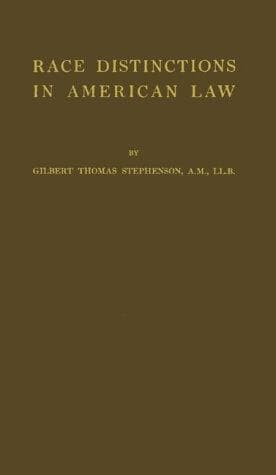
Race Distinctions in American LawStephenson, Gilbert Thomas
History
Race Distinctions in American Law
Stephenson, Gilbert Thomas
African Americans -- Politics and government; Law -- United States -- History; United States -- Race relations
The Raleigh, N. C., _News and Observer_ of February 20, 1906, quotes the
Germantown, Pa., _Guide_ as calling on the people to provide a cemetery
where Negroes may be buried, saying that “unless something is done, the
bodies of the colored poor will be denied the right of decent burial,
for their disposal, of necessity, will be by means of the dissecting
rooms of anatomical boards.”
The Civil Rights Bills of the eighteen States have now been analyzed,
and the judicial decisions arising therefrom have been considered. It is
noticeable that, if one excepts the theatre cases of the Reconstruction
period, not a case has come from a Southern State. The explanation must
be that those States have never undertaken to require hotel-keepers,
etc., to offer accommodations without regard to color: the Negroes have
taken for granted that they would not be admitted to such places, except
upon condition that they would accept the accommodations set apart for
their race, and consequently have not applied for admission upon any
other terms. In the other States the courts have, as a rule, interpreted
the Civil Rights Bills very strictly. If a place is not specifically
mentioned in the statute, courts have been very slow to include it under
the general head of “other places of amusement or accommodation.” In
other words, this phrase, which is, in substance, tacked on to every
statute, is a dead letter. The courts are chary, as they should be, of
invading individual liberty and freedom of business. But if a place is
specifically mentioned in the statute, the law is not satisfied by
offering separate accommodations to Negroes, even though such
accommodations are equal for both races in every respect; they must be
identical.
RACE DISCRIMINATION BY INSURANCE COMPANIES
Some allied topics may be properly discussed under the general head of
civil rights.
Public-domain text, read in full here on John Shaqi.
Reviews
Reviews
No reviews yet
Be the first to share your thoughts on this work.
Elsewhere in the archive
Join the Discussion
Join the discussion
Sign in to leave a comment or review.
Sign InorCreate an account