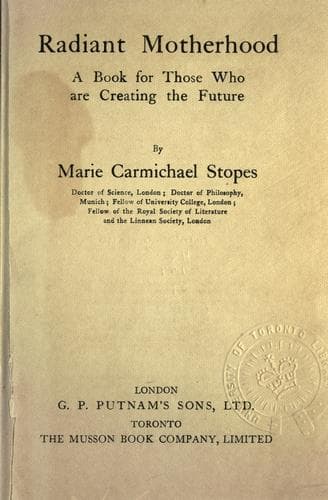
Radiant Motherhood: A Book for Those Who are Creating the FutureStopes, Marie Carmichael
Science
Radiant Motherhood: A Book for Those Who are Creating the Future
Stopes, Marie Carmichael
Mothers
Earlier civilizations often dealt with the excessive births resulting
from blind or coerced parenthood by destroying the children as infants
after birth. This was done directly, and often by her leading citizens,
in Greece (one of the highest forms of civilization ever attained) and
_still_ infanticide direct or indirect goes on among all the populous
races of the world. Where the value placed on the mother’s mental and
physical suffering is low, one may still see motherhood, not as a fine,
voluntary and glorious act of self-sacrifice from the highest possible
motives of love and service directly to the beloved, and indirectly to
the race, but as the exploitation of a trapped and helpless sacrifice.
Mothers will say that their babies are their greatest joys; one may
ask, therefore, how I can use the word “sacrifice” in connection with
motherhood. The use of the word is just, and based on truths too
generally concealed by those who know them, and far too generally
unknown by those who ought to know them. Ignorance of their extent has
made men callous, indifferent or ribald towards the profound sacrifices
of motherhood.
Few there be, however, who do not know of the agonizing torments of
actual birth. The Bible is read aloud in churches, and in its wording
there is some recognition of the existence of this agony, although
based upon earlier and simpler civilizations in which the women were
probably better cared for and better fitted for motherhood than the
majority of women are to-day. Following biblical tradition, the memory
of the agony of birth is generally portrayed as being wiped out by
the supreme joy in the child which follows. To-day, however, this
effacement of the anguish is by no means universal, and the abiding
horror of the birth is so great that not a few women refuse to bear
another child. Then men, who cannot even imagine the experience of
child-bearing, denounce such a mother, rate her and hold her up to
derision. How little do they realize that in her they may see Nature’s
working of the laws of evolution (see p. 24).
Public-domain text, read in full here on John Shaqi.
Reviews
Reviews
No reviews yet
Be the first to share your thoughts on this work.
Join the Discussion
Join the discussion
Sign in to leave a comment or review.
Sign InorCreate an account