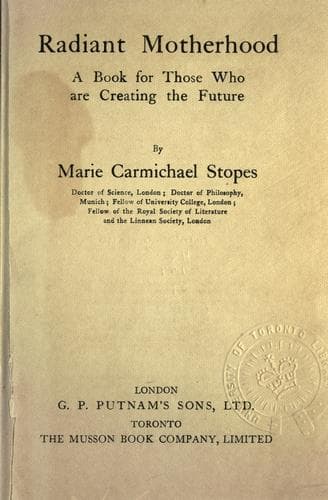
Radiant Motherhood: A Book for Those Who are Creating the FutureStopes, Marie Carmichael
Science
Radiant Motherhood: A Book for Those Who are Creating the Future
Stopes, Marie Carmichael
Mothers
Often to-day the betrothed young couple will speak openly and
beautifully of the children they hope to have, while others equally
full of the creative dream feel it too tender a subject to put into
words, and may marry without ever having given expression to the
possibility that they will generate through their love yet other
lovers.
CHAPTER II
Conceived in Beauty
... Here in close recess
With flowers, garlands and sweet smelling herbs,
Espousèd Eve deck’d first her nuptial bed,
And heav’nly choirs the Hymenæan sung,
What day the genial angel to our sire
Brought her in naked beauty more adorn’d,
More lovely than Pandora, whom the Gods
Endow’d with all their gifts....
... Into their inmost bower
Handed they went; and, eased the putting off
Those troublesome disguises which we wear,
Straight side by side were laid; nor turn’d, I ween,
Adam from his fair spouse; nor Eve the rites
Mysterious of connubial love refused:
* * * * *
These, lull’d by nightingales, embracing slept,
And on their naked limbs the flowery roof
Shower’d roses, which the morn repaired. Sleep on,
Blest pair, and O! yet happiest if ye seek
No happier state, and know to know no more.
MILTON: _Paradise Lost_.
In ancient Sanskrit, there is a work dealing minutely with love and
with the different forms its expression takes in different types of
people. This has been modified, added to and re-written by many later
authors, and under various names works based on this are to be found in
Sanskrit and translated into various Indian dialects.
In these volumes much that is curious, and to Western nations, absurd,
is to be found, but also several profound observations which appear
to be based on truths generally ignored by us. One of the interesting
themes of these very early writers is a recognition and a description
of the characteristics of the best and most perfect type of woman, the
“Padmini.” In addition to describing fully her physical appearance and
characteristics, it is observed that she being a child of light and
not of darkness, prefers the supreme act of love to take place in the
daylight rather than the dark.
Public-domain text, read in full here on John Shaqi.
Reviews
Reviews
No reviews yet
Be the first to share your thoughts on this work.
Join the Discussion
Join the discussion
Sign in to leave a comment or review.
Sign InorCreate an account