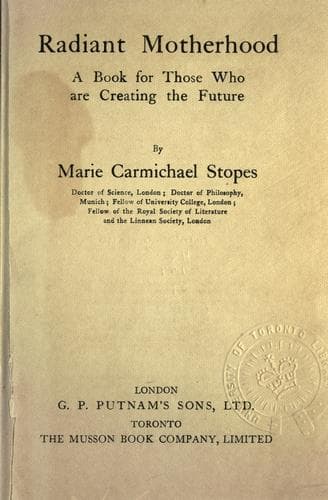
Radiant Motherhood: A Book for Those Who are Creating the FutureStopes, Marie Carmichael
Science
Radiant Motherhood: A Book for Those Who are Creating the Future
Stopes, Marie Carmichael
Mothers
TAGORE: _Gitanjali_.
One of the great sources of disharmony in our social life is the extent
of the extraordinary ignorance about ourselves which still persists.
From this spring our conflicting opinions and diametrically opposed
views, and also the apparently self-contradictory evidence on almost
any point of fundamental importance which is brought before the public.
In no respect is there more conflict of opinion than concerning the age
at which a woman should marry and become a mother. On the one hand,
we have advocates of very early motherhood, and they point to the fact
that a girl of seventeen is often already a woman and strongly sexed;
they point to the hackneyed statement “that a girl matures sooner than
a boy”; they point to the fine and healthy babies which very young
mothers may bear and to the greater pliability and ease of birth,
and these facts and their arguments may appear conclusive. On the
other hand, the actual experience of many people conflicts with these
apparently justified conclusions.
All the highly evolved races tend to prolong childhood and youth. All
tend to replace early marriage by later marriage and parenthood to the
obvious advantage of the race.
Marriage and parenthood at fourteen, fifteen and sixteen, which once
were common in almost every country, are being replaced by later
marriage and parenthood. As Finot 1913 says:--
A mystic chain appears to attach the age for love to the
consideration enjoyed by women. In the Far East, woman is offered
very young to the passion of man, and disappears from existence at
the time her contemporaries are just beginning to live. Love, for
this very reason, has a purely sensual stamp, degrading to man and
to woman. The lengthening of the age of love elevates the dignity,
and at the same time increases the longevity, of woman. Beyond
the age of thirty or forty the woman, dead to love, was fit only
for religion or witchcraft. Her life was shattered. Prematurely
aged she went out of the living world. The prolonged summer of
Saint-Martin in women will doubtless have consequences which
we should be wrong to fear. There is a solidarity of ages. The
cares bestowed on the child benefit the old man. The enlargement
of the age of maturity allows the child longer to enjoy the
years of life that are intended to form bodies and souls.... The
sentimental life of the country has undergone similar results.
Balzac, in proclaiming the right to love on the part of the woman
of thirty, aroused in his contemporaries astonishment bordering on
indignation. In his day, was not a man of forty-four considered
an old man?[6] Let us not forget that forty or fifty years before
Balzac, a philosopher like Charles Fourier, despairing of the
sentimental fate of young girls who had not found a husband before
the age of ... eighteen years, claimed for them the right to throw
propriety to the winds.
Public-domain text, read in full here on John Shaqi.
Reviews
Reviews
No reviews yet
Be the first to share your thoughts on this work.
Elsewhere in the archive
Join the Discussion
Join the discussion
Sign in to leave a comment or review.
Sign InorCreate an account