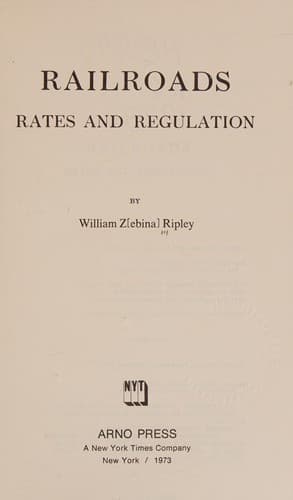
Railroads: Rates and RegulationsRipley, William Zebina
History
Railroads: Rates and Regulations
Ripley, William Zebina
Railroads -- Freight -- Rates -- United States; Railroads and state -- United States
This ever-present incentive to widen the market carries with it a
direct consequence. A market is a commercial area characterized by a
prevalent equality of prices. Phenomenal development in this respect is
characteristic of the United States. For many commodities the market
is coextensive with the national domain. It is the chosen function of
transportation agents, by rail and water, to ensure this result; to
preserve an equality of prices, despite the variety of producing and
consuming conditions. The railway is the agent by which the market is
thus widened and rivalries are thus equalized. In railway parlance
this is what is known as "keeping everyone in business." The following
quotation from the Senate Committee Hearings of 1905 adequately
describes the process: "I am interested in the erection of a mill
that has just been completed, and sometime since I was figuring on
the question of a smokestack. I wanted to have that stack built out
of brick that is burned in New Jersey, and that is several hundred
miles away. It is a long way to ship freight from New Jersey to North
Carolina. A quotation was made me by the stack builder, whose office
is in New York, and I remarked to him, 'That price is prohibitive; I
cannot pay that price for that stack.' He said, 'That is the best I
can do; but if you will tell me what you can afford to pay for that
stack, in competition with home-burned brick, I will see what I can do
with the railway people.' He said, 'All right; I will take it up with
the railway people.' His quotation included the delivery of the brick
and the erection of the stack at my plant. It would require something
like about fifty carloads of brick to build that stack. Within a week
he had his price revised, and gave me a satisfactory quotation and
took my contract for the stack. Of course he had to get a special rate
from the railway people, because there is no regular tariff on brick
from New Jersey to North Carolina." In this instance the railways
actually created this new business by so adjusting the margin between
the minimum cost of making brick in New York and in North Carolina,
as to make it possible for the traffic to move. The special rate here
mentioned, however, should be carefully distinguished from a secret
rebate offered to one contractor as against another in the same place.
This commodity rate, while special to meet a particular contingency,
was open to any other shipper similarly circumstanced. The student
cannot too carefully discriminate between these two sorts of special
rates. They are constantly confused in the public mind. The effect of
these open commodity rates, is not to create difference of opportunity
between individuals, but to generalize economic conditions and equalize
prices throughout wide areas.
Public-domain text, read in full here on John Shaqi.
Reviews
Reviews
No reviews yet
Be the first to share your thoughts on this work.
Elsewhere in the archive
Join the Discussion
Join the discussion
Sign in to leave a comment or review.
Sign InorCreate an account