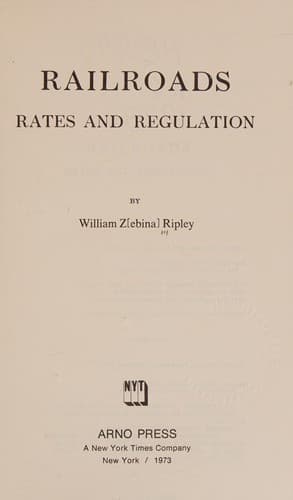
Railroads: Rates and RegulationsRipley, William Zebina
History
Railroads: Rates and Regulations
Ripley, William Zebina
Railroads -- Freight -- Rates -- United States; Railroads and state -- United States
The most satisfactory way to describe commercial competition as applied
to carriers is by concrete illustrations. There are two distinct
varieties or degrees of it, which may be denominated primary and
secondary. These might as properly, perhaps, be called simple and
complex, or direct and indirect. Of these, the first concerns those
cases wherein a commodity undergoes no physical transformation between
producer and consumer. Shipments are usually direct. Only one rate is
involved. Shall St. Louis and the South, for example, be supplied with
salt from the Kansas or Michigan fields?[84] This is a case of pure
transportation,--the creation of place value, alone. The Aroostook
farmers of Maine compete in prices with the potato growers of Michigan
in the New York market. Each district is usually represented by a
railway, dependent upon the prosperity of its particular constituency.
Competition of markets is usually more keen where a number of
carriers are concerned, each representing its own clients; but it
may conceivably arise as between several markets served by the same
company, especially with the growth of great railway systems. The
Southern Pacific must insure a rate from California on oranges to
eastern markets, as compared with the rates over the southern roads
from Florida, sufficiently low to warrant the venture of capital in the
industry.[85] Marble from the quarries of Vermont and North Carolina,
and paving blocks from the Lithonia district in Georgia and from
Wisconsin or South Dakota, must meet in Chicago on even terms. Such
competition, although simple and direct, recognizes no national bounds.
Copper from Montana must be laid down in Liverpool at rates to permit
of meeting the price on Chili bars from South America. Our entire grain
and cotton crops must be transported at rates which will enable them
to hold their own in European markets. The California raisin has, in
this manner, had to make its way into Eastern markets in the United
States against the pressure of importations from Spain, as described
in another place.[86] The cotton mills in New England and in the
South must have their output carried to China under conditions which
will enable them to meet the price made by the British manufacturer.
This last instance, however, introduces us to the second form of
competition; inasmuch as a double transportation is involved first from
the fields to the mill, and thereafter from the mill to the consumer.
Public-domain text, read in full here on John Shaqi.
Reviews
Reviews
No reviews yet
Be the first to share your thoughts on this work.
Elsewhere in the archive
Join the Discussion
Join the discussion
Sign in to leave a comment or review.
Sign InorCreate an account