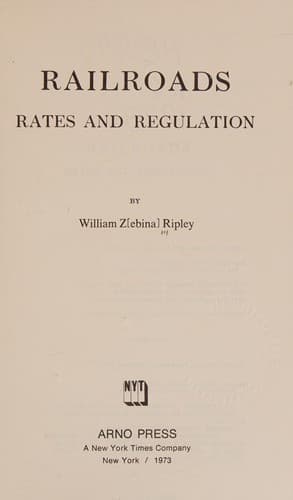
Railroads: Rates and RegulationsRipley, William Zebina
History
Railroads: Rates and Regulations
Ripley, William Zebina
Railroads -- Freight -- Rates -- United States; Railroads and state -- United States
By this time in our ascending scale of complexities, it will be
observed that manufacture now begins to outweigh mere transportation
in importance. With low-grade products, like salt or sugar, the
increment of value due to transportation is relatively high as
compared with manufacturing costs. As the grade of product rises,
however, the differences in value and in form between the raw and the
finished product, render the problem of location of the manufacture
more difficult as affected by the relative adjustment of rates of
transportation for the two. According to the data of the Federal Bureau
of Corporations, the cost of refining crude petroleum, worth three to
four cents a gallon at the wells in Pennsylvania, should not exceed
one-half cent a gallon. This sum would barely pay for the first hundred
miles of its carriage by rail, as ordinarily shipped. The market is,
of course, extraordinarily extensive; hence the persistent flagrancy
of the practices of secret rebating by the Standard Oil Co.[90] To
obtain such special favors in transportation outweighed in importance
the incentive to introduce economies in production. In this industry,
where little waste occurs in manufacture, the refineries may well be
located at the consumers' door. The manufacture of furniture for the
Pacific states, on the other hand, must be located "next the stump," in
North Carolina or New England. The long carriage must be applied, not
to the bulky lumber but to the finished product. The freight rate on
lumber from Oregon to Pittsburg is just about equal to the value of the
logs at the mill. Obviously, the large proportion of waste or common
lumber will not bear a high addition to its cost by carriage to any
distance. In the manufacture of fur hats a shrinkage of weight occurs
of one-half between the fur scraps and the finished product. In such
a case it is imperative, either that the factory be near the source
of supply or that the rate on the two distinct commodities be nicely
adjusted. The decision of the United States Steel Corporation to build
a large plant at Duluth for supplying the northwestern market is the
outcome of such considerations. The main point is that the adjustment
of a number of rates may determine, not only the general welfare of the
industry but even its specific geographical location with reference to
the raw material on the one side and the market on the other.
Public-domain text, read in full here on John Shaqi.
Reviews
Reviews
No reviews yet
Be the first to share your thoughts on this work.
Elsewhere in the archive
Join the Discussion
Join the discussion
Sign in to leave a comment or review.
Sign InorCreate an account