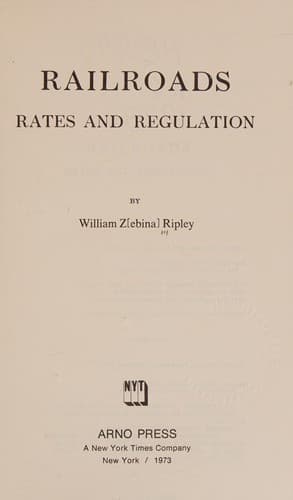
Railroads: Rates and RegulationsRipley, William Zebina
History
Railroads: Rates and Regulations
Ripley, William Zebina
Railroads -- Freight -- Rates -- United States; Railroads and state -- United States
Secondary or indirect forms of commercial competition in
transportation, concerning, as has been said, not one but two distinct
carriages of entirely different goods, needs to be in turn subdivided
still further. The products of agriculture and mines afford the best
instances. The lumber business is peculiarly suggestive in this
connection, owing to the fact that in the United States a vast treeless
area in the Middle West is surrounded with forest tracts available
for development. The market again in this case is limited only by our
national frontier. Omaha is supplied with yellow pine and cypress from
Louisiana after a 1,200-mile haul; Oregon fir brought 1,800 miles in
each instance for fifty cents per hundred pounds; and with Michigan
hemlock and pine transported less than 500 miles for eleven and a half
cents. These various sorts of lumber are all more or less competitive.
And in each case the final cost of laying down the product in Omaha is
determined; first, by the rate from the stump to the mill, and then,
as sawed lumber, thence on to destination. The Eau Claire, Wisconsin,
lumber case[87] before the Interstate Commerce Commission, fully
describes the intricacies of adjustment needed to hold a number of
such producers on a parity. In this instance Eau Claire, "next the
stump," as an important lumbering centre was shown to be declining in
importance relatively to Mississippi river towns, which received their
logs by raft down stream. A differential of a few cents was threatening
the welfare of a considerable population. The Wichita, Kansas, cases
are suggestive in a similar way.[88] Sugar is laid down at this market
from every point of the compass. From Hawaii it is shipped in the
raw state to San Francisco, and then brought East, like the Oregon
lumber, cheaply, as a back-load to counter-balance westbound shipments
of grain and manufactures. From New Orleans refineries comes the
Louisiana product, and from the Atlantic sea ports the Cuban sugar; but
in each case the carriage is broken at an intermediate point, at which
manufacture or jobbing ensues. A large class of operations analogous to
this, known as "milling in transit" and "floating cotton," elsewhere
described in detail, involve the same complexity and interrelation of
rates.[89] The point to carry forward is that commercial competition
demands that in every case not single rates but the sums of all the
connecting rates for each competing person or region shall be properly
adjusted. If this be not done, some one will be excluded from the
market and "put out of business."
Public-domain text, read in full here on John Shaqi.
Reviews
Reviews
No reviews yet
Be the first to share your thoughts on this work.
Elsewhere in the archive
Join the Discussion
Join the discussion
Sign in to leave a comment or review.
Sign InorCreate an account