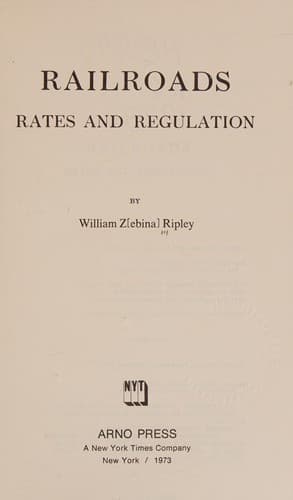
Railroads: Rates and RegulationsRipley, William Zebina
History
Railroads: Rates and Regulations
Ripley, William Zebina
Railroads -- Freight -- Rates -- United States; Railroads and state -- United States
This committee in turn referred the matter to Commissioner Albert
Fink, "Seeking a relativity of rates so as to make the charges for
transportation, including the expenses incident to the transportation
of dressed beef, the same per pound as the charges per pound of
dressed beef transported to the East in the shape of live stock." A
difficult task this, considering the variety of by-products emerging
into value year by year. Cattle rates had been for some time fifty-two
per cent., and then later sixty per cent. of the dressed beef rates.
This was relatively higher for cattle than had been charged during the
seventies. But the western packers demanded that the relativity in
favor of the finished product be still further advanced until cattle
rates should equal seventy-five per cent. of the rates on beef. This
would effectually discourage the shipment of cattle to eastern centres,
and would tend to upbuild Kansas City and Chicago at their expense.
In 1884, the matter being still in dispute, was referred to Hon. T.
M. Cooley, afterward chairman of the Interstate Commerce Commission.
He decided that a fair compromise would be forty cents on cattle from
Chicago to New York with coincident rates of seventy cents on beef.
This would make the cattle rate about fifty-seven per cent. of the beef
rate. It was a victory for the stockmen as against the western packers,
who at once raised a great outcry.
It would have been difficult to predict the final outcome had not an
entirely new factor appeared, which transformed the conduct of the
beef packing industry.[113] Specially constructed stock cars owned by
private companies began to be built. These favored the perpetuation of
competition between eastern and western packers. To checkmate this,
the western packers had already embarked in 1879 upon the ownership of
privately owned refrigerator cars for the carriage of their finished
products. The custom was adopted by the railways of paying for the use
of these cars by making an allowance of so much a mile as a deduction
from the established tariffs. This at once opened the way to secret
rebates of all sorts. The refrigerator traffic in these private cars
was large in volume, very regular and highly concentrated as to source.
A large tonnage could be diverted at any time to that road which
could best show its appreciation of the favor. The Grand Trunk, for
instance, in 1887 swept the board, monopolizing this entire business
for a brief time, obtaining it by secret and discriminating rates. The
railways, jointly, sought to free themselves from the domination of
the large packers; but the phenomenal growth of their business, both
domestic and export, rendered them too powerful to resist. According to
expert data, during nine months to May 1, 1889, three shippers alone
received from one line of road $72,945 for the use of their cars. This
about equalled the initial cost of eighty new cars. For the fiscal
Public-domain text, read in full here on John Shaqi.
Reviews
Reviews
No reviews yet
Be the first to share your thoughts on this work.
Elsewhere in the archive
Join the Discussion
Join the discussion
Sign in to leave a comment or review.
Sign InorCreate an account