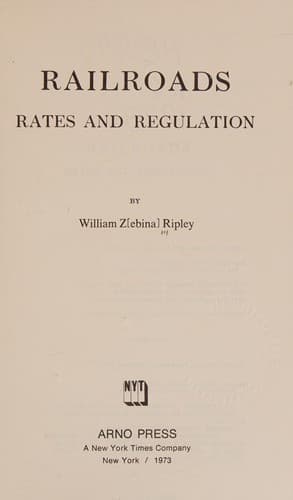
Railroads: Rates and RegulationsRipley, William Zebina
History
Railroads: Rates and Regulations
Ripley, William Zebina
Railroads -- Freight -- Rates -- United States; Railroads and state -- United States
year 1895, $8,744,000 was paid by the railways of the United States
for the use of these cars--about $4,000,000 of this being in the form
of rental. At this rate, profits of from twenty-five to fifty per
cent. upon the investment accrued to the great packers. These virtual
rebates, of course, drove all competitors from the field. The story
of the gradual extension of this system of private cars to include
fruit and produce business belongs in another place. Suffice it to say
that the bondage was broken only by the passage of the Hepburn Act of
1906. The growth of these private refrigerator car lines caused the
disappearance of live stock shipments. Packing and slaughtering on a
large scale at the seaboard, either for domestic consumption or export,
was doomed. Meantime, however, the controversy over the relative rates
on beef and cattle continued just as if anything really depended upon
it. The issue was again submitted to the commissioner of the Trunk
Line Association in 1887. In the following year a select committee
of the United States Senate was appointed at the urgent request of
the cattle raisers. Testimony before this committee showed in detail
how eastern packers were striving to build up establishments near
the points of consumption, but were driven out of the business by the
relatively high costs of shipping cattle, as compared with the rates
at which dressed beef could be actually delivered from Chicago and
Missouri river points. This entire history, aside from its significance
as a study of personal discrimination, illustrates the effect of
a relatively increasing differential rate, partly open and partly
secret, against the raw material of an industry as compared with the
finished product. The result, at all events, has been to concentrate
the packing industry in the Middle West. Nor is the controversy closed
even yet.[114] But this time it is a question, not between the seaboard
and Chicago, but between Chicago and Missouri river points, or those
still nearer the southwestern ranges. Fort Worth and Oklahoma City now
become complainants against the Missouri river points.[115] Always and
everywhere the manufacture seeks to develop at or near the source of
the raw material. Whenever this tendency does not appear in an industry
it is pertinent to inquire how far the relative adjustment of rates is
responsible for the phenomenon.
Public-domain text, read in full here on John Shaqi.
Reviews
Reviews
No reviews yet
Be the first to share your thoughts on this work.
Elsewhere in the archive
Join the Discussion
Join the discussion
Sign in to leave a comment or review.
Sign InorCreate an account