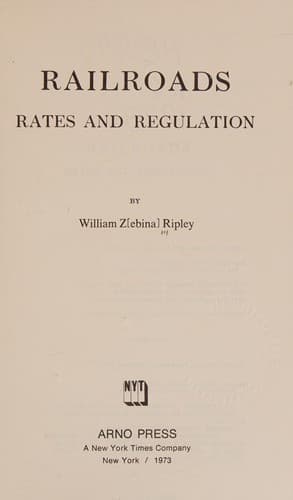
Railroads: Rates and RegulationsRipley, William Zebina
History
Railroads: Rates and Regulations
Ripley, William Zebina
Railroads -- Freight -- Rates -- United States; Railroads and state -- United States
cents, and that put the Kansas mills out of business."
Apparently insignificant details often determine the outcome of
commercial competition. Thus in the milling business, where the margin
of profit in the manufacture of flour may not be over three cents per
barrel, an infinitesimal change in the freight rate may mean success
or failure to long-established industries. And the conditions vary
indefinitely. Thus, as between flour milling in Duluth and Buffalo,
Duluth can buy its wheat from the farmer direct during the entire
winter, but must ship its product mainly during the period of open
water navigation on the lakes. The reverse is true with the Buffalo
miller who can ship out his flour during the entire season, but who
must accumulate his whole stock of wheat before navigation closes. And
then Minneapolis as a milling centre has to be taken into account.
Eighty per cent. of the spring wheat grown in the United States is
in territory from which the freight rates to Minneapolis and Duluth
are the same. But the basic rate to the East and Europe, fixing the
all-rail rates, is the combined lake and rail. By this route Duluth
is one hundred and fifty miles nearer the market than is Minneapolis,
and consequently enjoys a lower rate on its flour shipped out. A
three-cornered competitive problem exists, in which any change at one
point entirely upsets the commercial equilibrium.
The obligation on the part of a railway to protect its constituency,
not only in respect of particular rates, but in general conditions as
well, introduces still further complications. The freight business
of New England, for example, consists, first, of the carriage of raw
materials and supplies inwards; and, secondly, thereafter of the
transportation of the finished product out to the consuming markets.
Narrowly considered, it may seem expedient to crowd the rate on coal
as high as the value of service probably will permit; but viewed in a
large way, it may prove to be a far better business policy to maintain
the rate on coal, cotton, and other staple supplies so low, that the
growth of population and production may in the long run yield far
greater returns on the high-grade manufactures which the territory
produces. Turning to the southern field, where the economic conditions
are reversed, it may be the better policy to hold down the rate on
raw cotton in order thereby to stimulate this great basic industry
and thereby enhance the demand for the merchandise and foodstuffs
which depend upon general prosperity. A free hand afforded for the
suitable adjustment of such apparently independent services may
contribute far more to the general welfare than an insistence upon
a petty and near-sighted policy of extorting from each individual
service all the rate it can possibly endure. American railway managers
are gradually but surely coming to take a more liberal view of these
great possibilities and to consider the economic development of their
Public-domain text, read in full here on John Shaqi.
Reviews
Reviews
No reviews yet
Be the first to share your thoughts on this work.
Elsewhere in the archive
Join the Discussion
Join the discussion
Sign in to leave a comment or review.
Sign InorCreate an account