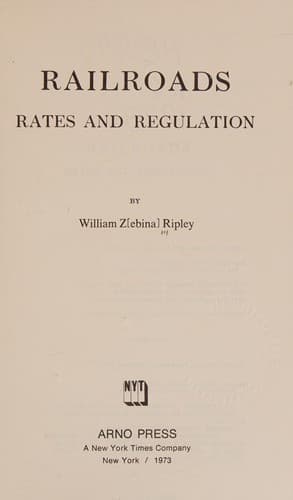
Railroads: Rates and RegulationsRipley, William Zebina
History
Railroads: Rates and Regulations
Ripley, William Zebina
Railroads -- Freight -- Rates -- United States; Railroads and state -- United States
rates upon wheat and corn had been fixed in a definite relation to
one another, based upon commercial experience. Any reduction of the
corn rate compelled a reduction of the wheat rate. A fall in the wheat
rate brought about a drop in the rate on flour. These reductions in
corn started in southern Kansas; but parallel lines in northern Kansas
were compelled to follow suit. Grain in the territory between the two
roads could be hauled by wagon either north or south corresponding
to a fraction of a cent per bushel difference in the price. Thus the
reduction in rates spread from one line to another all over Kansas,
throughout Nebraska up into Dakota and finally to Minnesota. It not
only affected the corn rate everywhere but it caused a reduction in the
rate on flour from Minneapolis to Chicago. The reliance of Texas for a
portion of its corn supply upon the surplus product of Kansas sometimes
leads to odd results. This commodity is sometimes shipped as corn meal
and sometimes transported as corn to be afterwards ground in Texas.
The Texas millers at one time demanded a relative reduction of the
rate on grain as compared with corn meal, and the railway commission
of that state upheld them in that demand. For ten years down to 1905
the differential in favor of the raw product had been three cents a
hundred pounds. Then the railways, in connection with a general advance
of rates, increased the charge on corn meal until it amounted to about
nine cents per hundred pounds more than the rate on corn. One cent a
hundred pounds being a good profit in grinding corn meal, this change
shut the Kansas millers out of Texas business. Application was made
to the Interstate Commerce Commission for relief. It then appeared
on investigation that the carriers had made use of the Texas millers
in order to prevent a general reduction of _both_ grain rates and
rates on grain products. The Texas millers on general principles had
favored both these reductions. What happened is best described in the
evidence before the Senate Committee on Interstate Commerce of 1905.
"The railways went to the millers of Texas and they said to them,
'Is there anything you want here?' 'Why,' said the [Texan] millers,
'yes; we would like to have that differential between corn and corn
meal increased; we think you ought to put the rate on corn meal up.'
The railway said, 'All right; you just stay away from that meeting
down at Austin so that there will not be any excuse for the Texas
commission, and if it undertakes to reduce these rates we will raise
this differential; we will raise the rate on corn meal to the rate on
flour.' The millers kept away from Austin--they kept their part of
the bargain--and they stayed away, and the Texas commission was left
without any support for their proposition to reduce the corn rates, and
the railway kept their part of the bargain and lifted up the rate on
corn meal so that the differential was from nine to seven and one-half
Public-domain text, read in full here on John Shaqi.
Reviews
Reviews
No reviews yet
Be the first to share your thoughts on this work.
Elsewhere in the archive
Join the Discussion
Join the discussion
Sign in to leave a comment or review.
Sign InorCreate an account