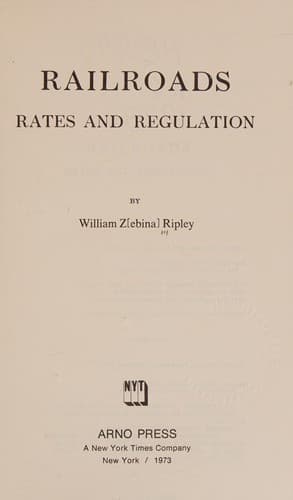
Railroads: Rates and RegulationsRipley, William Zebina
History
Railroads: Rates and Regulations
Ripley, William Zebina
Railroads -- Freight -- Rates -- United States; Railroads and state -- United States
independently acknowledged them to be just, but simply and solely
because any disturbance of this house of cards might lead to a general
downfall of the whole system.
Another interesting example of the difficulty of bringing about a
change in rate adjustment is afforded in the transcontinental field.
For some years a general agreement seems to have been adopted as a
sort of a compromise between the various conflicting interests. Under
present conditions Chicago and all points east of the Mississippi
from Maine to Florida enjoy precisely the same rate to the Pacific
coast.[129] Chicago has at various times contended before the
Interstate Commerce Commission for graded rates which should recognize,
for instance, that being 1,200 miles nearer San Francisco than Boston
on the basis of distance, it should have proportionately lower freight
rates. Apparently some of the transcontinental roads, such as the Great
Northern, have been willing to make this concession. They could not,
however, take any action without first obtaining the consent of every
railway and steamship company with which they compete. Inasmuch as
almost every railway in the country participates in transcontinental
business, an agreement was practically impossible. Entirely aside from
the merits of this particular intricate question, it must be borne in
mind that there is no such thing as independence of action on behalf of
any single carrier. It becomes exceedingly easy for one road to play a
dog-in-the-manger part. The shipper may be subjected to an extortionate
policy, not dictated by the road over which he ships, as a matter of
fact, but by roads operating perhaps a thousand or more miles away.
Praiseworthy as is the elasticity of railway rates in the United
States, there is, nevertheless, much to be said in support of the
contention that at times this has been carried to an extreme. Stability
and certainty have been treated as of secondary importance. Particular
shippers have been aided, but the general interests of trade have
suffered some injurious consequences. It is not entirely clear whether
the advantage gained from elasticity has at all times been worth the
cost. Certain of the disadvantages of instability of rates seem to have
been overlooked.
Public-domain text, read in full here on John Shaqi.
Reviews
Reviews
No reviews yet
Be the first to share your thoughts on this work.
Elsewhere in the archive
Join the Discussion
Join the discussion
Sign in to leave a comment or review.
Sign InorCreate an account