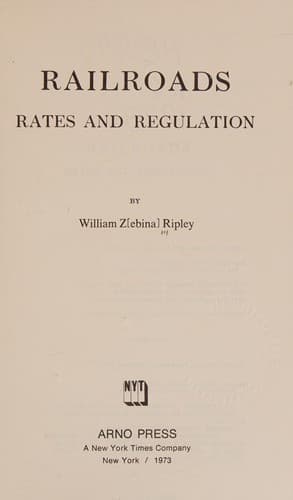
Railroads: Rates and RegulationsRipley, William Zebina
History
Railroads: Rates and Regulations
Ripley, William Zebina
Railroads -- Freight -- Rates -- United States; Railroads and state -- United States
In the first place railway tariffs have in the past undoubtedly
been too voluminous and complex. The number of these filed with the
Interstate Commerce Commission is extremely large. Eleven railways
alone during the year to November 30, 1904, filed 30,125. The total
schedules of all American railways filed during the year to November
30, 1907, was 220,982. One single carrier had 15,700 tariffs in force
at the same time. The New York Central & Hudson River in December,
1899, had no less than 1,370 special commodity rates in force. There
were endless contradictions and conflicts. Secret rates were hidden in
devious ways in this mass of publications. Special tariffs "expiring
with this shipment"; rates quoted not numerically but by numbered
reference to tariffs of other carriers and applicable by different
routes; agreements to meet rates of any competing carriers, were among
the irregular methods of concealment adopted. Although literally
complying with the law by publicly filing all tariffs, conditions
were often such that not even an expert in rates could discover in
this maze of conflicting evidence what the rate at any time actually
was. The door was opened wide to personal discrimination and abuses
of all kinds.[130] Those conditions are not necessary. They do not
obtain on the best roads in other parts of the world. Nor is such
instability found in respect of some important lines of trade. No
agricultural product fluctuates in price more abruptly or widely than
raw cotton,--from five to seventeen cents a pound. Yet the rates on
that commodity have remained quite undisturbed throughout the southern
states for many years. But the best proof of all that rates have been
unduly numerous, is the great reduction in volume which has taken place
since 1910 under compulsion of law. This feature will be especially
considered in another connection.[131]
Public-domain text, read in full here on John Shaqi.
Reviews
Reviews
No reviews yet
Be the first to share your thoughts on this work.
Elsewhere in the archive
Join the Discussion
Join the discussion
Sign in to leave a comment or review.
Sign InorCreate an account