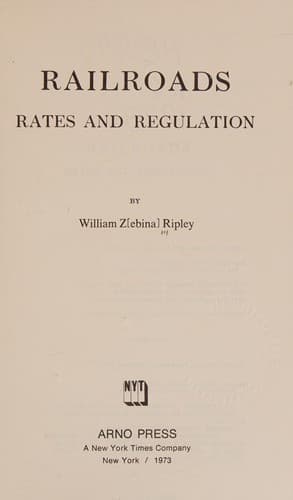
Railroads: Rates and RegulationsRipley, William Zebina
History
Railroads: Rates and Regulations
Ripley, William Zebina
Railroads -- Freight -- Rates -- United States; Railroads and state -- United States
This will do little toward
paying repairs, but that little is better than nothing. If you take at
eleven cents freight that cost you twenty-five cents to handle, you
lose fourteen cents on every ton you carry. If you refuse to take it at
that rate, you lose fifteen cents on every ton you do not carry. For
your charges for interest and repairs run on, while the other road gets
the business."[138]
Another peculiarity of railway competition, distinguishing it from
competition in trade, is that there is no such thing as abandonment of
the field. This is tersely expressed by Morawetz in his Corporation
Law. "It should be observed that competition among railway companies
has not the same safeguard as competition in trade. Persons will
ordinarily do business only when they see a fair chance of profit, and
if press of competition renders a particular trade unprofitable, those
engaged in that trade will suspend or reduce their operations, and
apply their capital or labor to other uses until a reasonable margin
of profit is reached. But the capital invested in the construction of
a railway cannot be withdrawn when competition renders the operation
of the road unprofitable. A railway is of no use except for railway
purposes, and if the operation of the road were stopped, the capital
invested in its construction would be wholly lost. Hence it is for
the interest of the railway company to operate its road, though
the earnings are barely sufficient to pay the operating expenses.
The ownership of the road may pass from the shareholders to the
bond-holders, and be of no profit to the latter; but the struggle
for traffic will continue so long as the means of paying operating
expenses can be raised. Unrestricted competition will thus render
the competitive traffic wholly unremunerative, and will cause the
ultimate bankruptcy of the companies unless the operation of their
traffic which is not the subject of competition can be made to bear
the entire burden of the interest and fixed charges." So profoundly
modified in short are the conditions of railway competition by contrast
with those in industry, that it is clear beyond a shadow of doubt
that a railway is essentially a monopoly. This requires no proof so
far as local business, in distinction from through or competitive
traffic, is concerned. It is equally true in respect to all traffic of
sufficient importance to bring about pooling agreements or a division
of the business, in order to forfend bankruptcy and consolidation.
To attempt to perpetuate competition between railways by legislation
is thus defeating its own end. The prohibition of pooling agreements
which refuses to recognize the naturally monopolistic character of the
business, can have but one result, namely, to compel consolidation as a
measure of self-preservation. Such legislation defeats itself, bringing
about the very result it was intended to prevent.
* * * * *
Public-domain text, read in full here on John Shaqi.
Reviews
Reviews
No reviews yet
Be the first to share your thoughts on this work.
Elsewhere in the archive
Join the Discussion
Join the discussion
Sign in to leave a comment or review.
Sign InorCreate an account