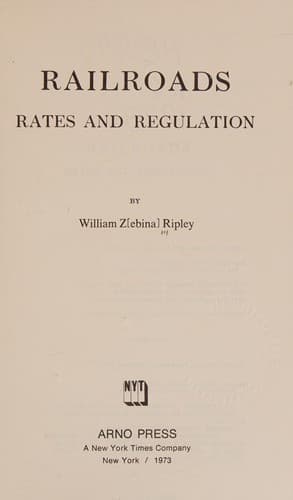
Railroads: Rates and RegulationsRipley, William Zebina
History
Railroads: Rates and Regulations
Ripley, William Zebina
Railroads -- Freight -- Rates -- United States; Railroads and state -- United States
Two general theories governing the rates chargeable by railways are
entertained, known respectively as cost of service and value of
service. According to the first, the proper rate for transportation
should be based upon the cost for carriage of the persons or goods,
with an allowance for a reasonable profit over and above the expenses
of operation involved. This line of argument is commonly advanced by
representatives of shippers and the public, who reason by analogy from
other lines of business. In several European countries when railways
were first built, and afterward, especially in Germany in 1867,
attempts were made to apply this principle widely in the construction
of tariffs. Practical railway men, on the other hand, usually adhere
to the second principle of value of service. This argument maintains
that, while theoretically cost of service should determine minimum
rates, owing to the nature of commercial competition, as a matter
of fact rates must be based upon the principle of charging what the
traffic will bear. This is accomplished by proportioning the rate to
the commercial value of the service. Practically the rate is found
by charging as much as the traffic will stand without evidence of
discouragement. Thus if the price per bushel of wheat in New York
is twenty-five cents higher than in Chicago, it would obviously be
absurd to charge a rate which would absorb all of that increment of
place value due to transportation. Enough margin must be left to the
shipper who buys wheat in Chicago and sells it in New York, to permit a
reasonable profit on the transaction, after payment of the freight rate.
Public-domain text, read in full here on John Shaqi.
Reviews
Reviews
No reviews yet
Be the first to share your thoughts on this work.
Elsewhere in the archive
Join the Discussion
Join the discussion
Sign in to leave a comment or review.
Sign InorCreate an account