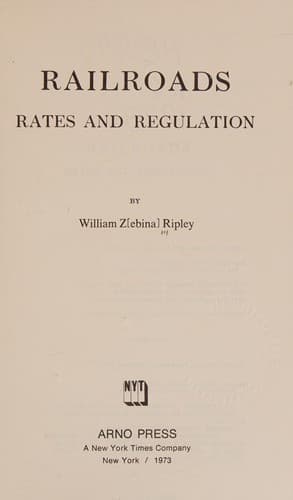
Railroads: Rates and RegulationsRipley, William Zebina
History
Railroads: Rates and Regulations
Ripley, William Zebina
Railroads -- Freight -- Rates -- United States; Railroads and state -- United States
There can be no question that for an indispensable public service
like transportation, conducted under monopolistic conditions, the
ideal system of charges would be to ascertain the cost of each service
rendered and to allow a reasonable margin of profit over and above this
amount. To the application of this principle alone, however, there are
several insuperable objections both theoretical and practical. Such
cost is practically indeterminate, being joint for all services in
large part, as we have seen: it is highly variable, being perhaps never
twice the same, as circumstances change from time to time; cost is
unknown until volume is ascertained, and volume is ever fluctuating;
the cost of service, obviously, could never be ascertained until after
the service had been rendered, while, of course, the schedule of rates
must be known in advance, in order that the shipper may calculate his
probable profits; and finally the principle of increasing returns,
flowing from the dependence of cost upon volume of traffic, imposes
such an incentive for development of new business, which in turn
depends for its volume upon the rate charged, that cost of service is
subordinated at once to other considerations in practice.
Of these objections to rate making upon the principle of cost of
service alone, it would indeed appear as if the first should be
conclusive. If the cost is simply indeterminable, why bother about any
further refutation of the principle at all? But the persistency of the
idea that somehow railway operations are analogous to the business of
an ordinary merchant; and that cost and profits are ascertainable;
renders it necessary to pile proof upon proof of the limitations upon
its applicability to real conditions in service.
Not only is the mere cost of service indeterminable; if it could
be ascertained, it would not establish the chargeable rate in many
instances. The freight service of a railway comprises the carriage of
all kinds of goods simultaneously, from the most valuable high-priced
commodities, such as silks and satins, down to lumber, coal, cement,
and even sand.[141] To compel each of these classes of goods to bear
its proportionate share of the cost of carriage, would at once preclude
the possibility of transporting low-priced goods at all. One dollar a
hundred pounds may not be too much to add to the price of boots and
shoes for transportation from Boston to Chicago.
Public-domain text, read in full here on John Shaqi.
Reviews
Reviews
No reviews yet
Be the first to share your thoughts on this work.
Elsewhere in the archive
Join the Discussion
Join the discussion
Sign in to leave a comment or review.
Sign InorCreate an account