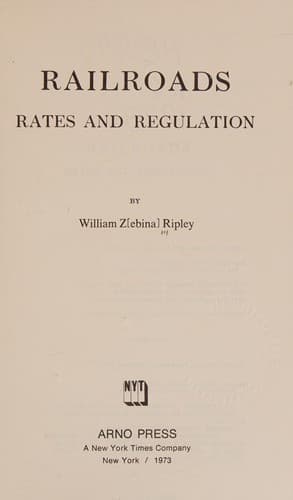
Railroads: Rates and RegulationsRipley, William Zebina
History
Railroads: Rates and Regulations
Ripley, William Zebina
Railroads -- Freight -- Rates -- United States; Railroads and state -- United States
It would still form only a small part of the total cost of producing
and marketing them. But to add anything like that sum to the cost of
one hundred pounds of salt or cement would put an end to the business
at once. Only about so much can in practice be added to the price of
any given commodity for freight without widely limiting the area of its
available market. Thus raw cotton seems to be able to bear an addition
of about fifty cents per hundred pounds for freight to its total cost.
Experience demonstrates that anything more than this one-half cent per
pound charged on cotton, entails more loss than gain. In the case of
fancy groceries or fine furniture, there may be no considerable demand
in any event above a certain ascertainable level of prices. For boots
and shoes or cut building stone it may be that competition from some
other centre of production nearby, precludes any great addition to
the price for freight. The business simply will not bear more than a
certain proportion of charge. Not only would the rigid application of
the cost of service principle hinder all transportation of low-grade
traffic; it would also prevent any development of long distance
business. It is indubitable that sole reliance upon cost of service as
a basis for rate making is theoretically unsound, and impossible of
practical application.[142]
Cost of service, while unsound as a sole reliance, nevertheless affords
an important check upon the value of service principle. Without it
there is always grave danger that traffic managers, seeking to enlarge
their revenues, may push rates unreasonably high. At first sight it
would appear as if this could not occur, inasmuch as an inordinately
high rate would immediately reduce the volume of business offered.
It is constantly alleged by railway men that this must of necessity
occur. And it would indeed follow, were it not that the incidence of
the rate is rarely upon the actual shipper. He merely pays it, and at
once shifts it to the consumer. For low-grade or staple goods like
cement or kerosene, where transportation charges form a large part of
the total cost of production, it is conceivable that higher freight
rates might so far increase the price as to check consumption. Five
cents a hundredweight higher freight means $1.25 per 1,000 ft. added
to the price of soft lumber, $2 to hard lumber; three cents per bushel
added to the price of wheat, and $1 to the ton of pig iron or coal.
Such substantial additions might readily reduce the demand. Yet even
this would not be true of necessities of life like anthracite coal
or sugar, on which latter the freight rate amounts to about one-half
cent per pound. Is five cents a barrel added to the price of flour
likely to decrease the consumption of that staple commodity? Yet the
enhancement of railway revenues would indeed be enormous from such an
increase of freight rates. For these necessities of life, an increased
Public-domain text, read in full here on John Shaqi.
Reviews
Reviews
No reviews yet
Be the first to share your thoughts on this work.
Elsewhere in the archive
Join the Discussion
Join the discussion
Sign in to leave a comment or review.
Sign InorCreate an account