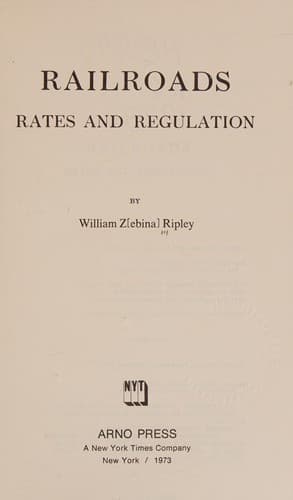
Railroads: Rates and RegulationsRipley, William Zebina
History
Railroads: Rates and Regulations
Ripley, William Zebina
Railroads -- Freight -- Rates -- United States; Railroads and state -- United States
freight rate might become an actual charge upon the people, without
reducing their consumption, like a tax upon salt. Only upon goods the
use of which might be freely lessened, would higher freight rates
be reflected in a corresponding decline in the volume of business.
Moreover, with all high grade traffic, the value of service principle
fails utterly by itself alone to prescribe the upper level of a
reasonable charge. Competent testimony is ample upon this point. Thus
from the commissioner of the Trunk Line Association;[143] "The tonnage
of the higher class articles is an extremely difficult matter for
transportation companies to increase or decrease.... In that class of
articles the carrier can do but little to increase the transportation."
And the reason in part lies in the almost immediate diffusion of the
burden in the processes of distribution. That no complaints are made--a
defence often brought forward for higher rates--proves by itself the
uncertain incidence of the burden imposed.
That the principle of charging what the traffic will bear affords
no protection to the consumer against exorbitant rates on many
commodities, follows also from the relative insignificance of
transportation charges as compared with the value of the goods. This,
in fact, is naively conceded by railway managers themselves; when,
as in the case of the widespread freight rate advances of 1908-1909,
publicity agents flooded the country with calculations as to the
infinitesimal fraction which would be added to the price of commodities
by a ten per cent, rise in rates.[144] The rate from Grand Rapids to
Chicago on an ordinary dining room set of furniture, being $1.60, a
ten per cent. increase would add only sixteen cents to the cost. A
harvester transported one hundred miles would be enhanced seventeen
and a half cents in price; a kitchen stove carried from Detroit to
the Mississippi would only cost twenty-five cents more; and the price
of a Michigan refrigerator sold in New York, would be only seven
and one-half cents higher; were freight rates to be increased by
ten per cent, in each instance. On wearing apparel the proportions
were represented as even more striking. An ordinary suit of clothes
transported three hundred miles, under similarly enhanced rates, would,
it was alleged, cost only one-third of a cent more. For all their
apparel, made in New England, consisting of everything from hats to
shoes, each wearer in the Middle West would be affected by a ten per
cent. rise of rates by less than one cent apiece. True enough all this;
and a striking testimonial to the effectiveness of the railway service
of the country! But at the same time, if a ten per cent. increase of
rates is inappreciable to the consumer, why not increase them by twenty
per cent.[145]
Public-domain text, read in full here on John Shaqi.
Reviews
Reviews
No reviews yet
Be the first to share your thoughts on this work.
Elsewhere in the archive
Join the Discussion
Join the discussion
Sign in to leave a comment or review.
Sign InorCreate an account