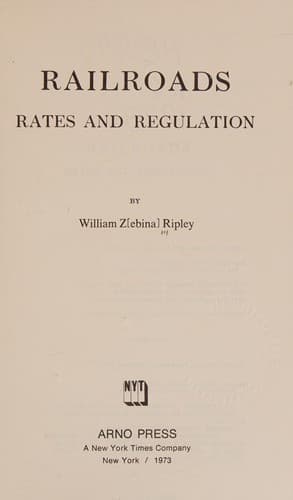
Railroads: Rates and RegulationsRipley, William Zebina
History
Railroads: Rates and Regulations
Ripley, William Zebina
Railroads -- Freight -- Rates -- United States; Railroads and state -- United States
Considerations of cost of service afford protection, not only against
unreasonably high rates, but also against unduly low charges. The evil
in such cases is not only that the carriers operate at a loss, but that
inequality and discrimination are inevitable concomitants of too low
rates. No railway conceivably, of course, will charge unremunerative
rates for a long time. But it sometimes happens that managements may be
led to the adoption of policies of temporary expediency, not compatible
with the long-time welfare of stockholders. During the presidency of
Charles Francis Adams on the Northern Pacific in 1890 an unaccountable
and unnatural diversion of traffic from this road to the Atchison,
Topeka & Santa Fe suddenly occurred.[150] A large volume of freight
from the East to Oregon was diverted to the roundabout route _via_
Southern California. On investigation it appeared that the English
banking house of Baring Brothers, having become involved in unfortunate
Argentine speculation, and being obliged to force a market for its
investments in Atchison securities, demanded an immediate showing of
large gross earnings regardless of the net profits. Orders to get
traffic at any price went forth. A market was made for Atchison stock;
although it was powerless to prevent the firm's final bankruptcy.
In such a case the only safeguard against unreasonably depressed
rates by the Atchison road, which, of course, immediately compelled
corresponding reductions by the natural routes to the Northwest, should
have been consideration of the actual cost of moving traffic by so
long and roundabout a route. And yet this consideration was entirely
ignored. Another illustration of the same danger occurred in April,
1903.[151] A gang of western speculators unobtrusively acquired control
of the Louisville & Nashville road, by taking advantage of the issue
by that company of a large amount of new stock. This they did by the
use of borrowed money. They had no intention, even had they been
sufficiently well financed to do so, of permanently controlling the
road as an investment. They bought the stock merely in order to resell
it at a higher figure. They threatened the railway world with a general
disturbance of rate conditions throughout the South. Their plan was
to cut rates and steal traffic from other roads in order to make a
large show of gross earnings; and to unload their stock holdings on
the market thus made, before the public learned the truth. This was
prevented only by repurchase of their stock at very high prices. In
such a case, what guidance would the principle of charging what the
traffic would bear, afford? Cost of service must be invoked in order to
determine the reasonableness of the low rates in force.
Public-domain text, read in full here on John Shaqi.
Reviews
Reviews
No reviews yet
Be the first to share your thoughts on this work.
Elsewhere in the archive
Join the Discussion
Join the discussion
Sign in to leave a comment or review.
Sign InorCreate an account