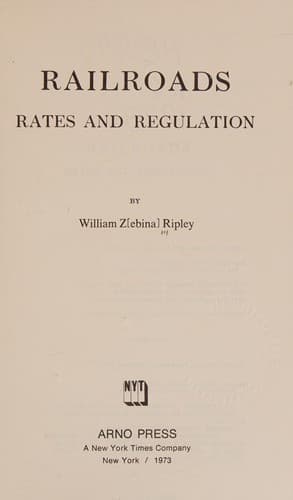
Railroads: Rates and RegulationsRipley, William Zebina
History
Railroads: Rates and Regulations
Ripley, William Zebina
Railroads -- Freight -- Rates -- United States; Railroads and state -- United States
In any industry where rates are made under conditions of monopoly
rather than of free competition, it is imperative that cost of service
be constantly held in view. Under conditions of free competition it
is bound to obtrude itself automatically; but under monopoly it must
oftentimes be forcibly invoked. The shipper whose manufacturing plant
has once been located in a certain place is no longer free to accept or
reject a certain rate. He can afford neither to move nor to abandon his
works. In order to continue in business he must meet the prices made
by competitors. This price may be made elsewhere under more favored
circumstances. To a manufacturer an increase of freight rates instead
of curtailing output, may lead to attempts to lessen the costs of
production per unit by an enlarged output sold at cut prices. Under
such conditions an enhanced freight rate is a positive deduction from
profits without any gain to the consumer. It is impossible to trace any
safeguard against extortion in the operations of a value of service
law under such circumstances. An instance in point is afforded by a
complaint of the Detroit Chemical works in 1908.[152] This company
imported iron pyrites through Baltimore from Spain; that being the
source of the bulk of the material used here in the manufacture of
sulphuric acid. The Detroit Company sold its product throughout the
West in competition with companies at St. Louis, Chicago and Buffalo.
The companies at Chicago and St. Louis enjoyed low import rates by way
of the Gulf ports. The Buffalo concern used to be favored by a low rate
said to be due to canal competition on shipments from New York. Since
1903, however, the rate on pyrites from Baltimore to Detroit had been
steadily increasing, from $1.56 to $2.72 per long ton. Even this latter
rate by itself does not seem absolutely excessive, yielding a revenue
of less than four mills per ton mile. But here again, it was not the
absolute but the relative rate upon which the continued welfare of the
industrial concern depended. The question had to be decided, not on the
basis of cost, but from the point of view of the value of the service
to the user. The carriers after this petition was filed voluntarily
reduced the rate fifty-one cents per ton in January, 1908. The relative
rate as compared with that to other competitive points was thus more
equitably adjusted. The Interstate Commerce Commission on a review of
the evidence held that this increase to $2.72 was unreasonable and
unjust so long as it had been in effect; and awarded reparation to the
amount of fifty-one cents per ton on all shipments made during its
continuance.
Public-domain text, read in full here on John Shaqi.
Reviews
Reviews
No reviews yet
Be the first to share your thoughts on this work.
Elsewhere in the archive
Join the Discussion
Join the discussion
Sign in to leave a comment or review.
Sign InorCreate an account