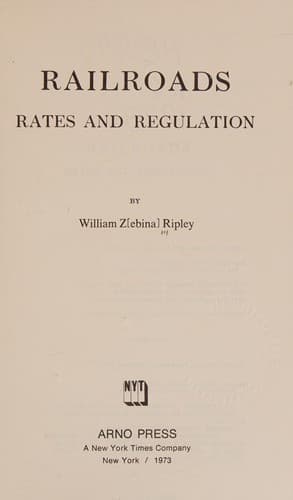
Railroads: Rates and RegulationsRipley, William Zebina
History
Railroads: Rates and Regulations
Ripley, William Zebina
Railroads -- Freight -- Rates -- United States; Railroads and state -- United States
rates, based directly upon what the traffic will bear, rather than upon
the element of cost, are likely to prevail in these cases. But the very
large revenue which could be obtained from increasing the rates upon
the higher grade of goods seems not to be fully appreciated.
A valuable instance of the play of opposing considerations of cost and
value of service in the classification of freight rates is afforded by
the complaint in 1908 of the pulp paper makers in Wisconsin, already
cited in another connection.[159] It appeared that for similar service
over the same roads, the rates per carload on saw logs for lumber were
only about one-half those charged for carriage of logs to be ground
into paper pulp. Judged on the basis of commercial value, hemlock and
spruce bolts, too short and often otherwise unfit for lumber, were
worth much less than saw logs; and yet they paid double the freight
rates. This was not because the pulp wood was less desirable as
traffic. In many ways it was more so. The haul was twice as long as for
saw logs. The paper mills brought relatively more supplementary tonnage
in the form of coal, food stuffs and supplies for workmen and their
families. Fully as much of the finished product to be reshipped to
consumers resulted. While smaller in volume, the pulp wood business was
far more permanent. It was growing rapidly while the lumber business
was declining. Moreover, the actual cost of service in hauling pulp
wood was fully as low as for lumber logs. Carloads were much heavier,
and were more regular in movement. In practice they involved no
milling-in-transit obligation, that is to say, no obligation to re-ship
the finished paper out over the same road; while all the saw log rates
carried this obligation--a matter of some moment to the railways. And
finally the value of the service to shippers of pulp wood was less than
to mere lumbermen; in other words, the paper makers were operating
under closer margins of profit; their plants were more costly, and
depreciated more rapidly. The defence of the carriers in this case was
not that the rates on pulp wood were too high in themselves, but that
the rate on saw logs was perhaps unduly low--the latter having been
crowded down to a minimum figure by competition in the early days of
the business by the lumber raftsmen who floated the saw logs downstream
from the forest to the saw mills. But of equal importance probably in
perpetuating the higher rates on pulp logs, was the assumption that
while the value of the bolts themselves was perhaps even less than
that of saw logs, the value of the resultant product, paper, was much
greater than that of lumber. But the Wisconsin Railroad Commission, in
entire harmony with the principle repeatedly laid down by the Federal
commission, held that the carriers must be guided by real distinctions
of cost from a transportation standpoint and not by gradations
of value. If the goods were bulky, awkward, or risky to handle,
Public-domain text, read in full here on John Shaqi.
Reviews
Reviews
No reviews yet
Be the first to share your thoughts on this work.
Elsewhere in the archive
Join the Discussion
Join the discussion
Sign in to leave a comment or review.
Sign InorCreate an account