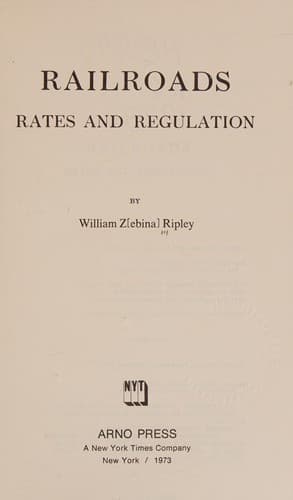
Railroads: Rates and RegulationsRipley, William Zebina
History
Railroads: Rates and Regulations
Ripley, William Zebina
Railroads -- Freight -- Rates -- United States; Railroads and state -- United States
perhaps requiring special appliances or equipment, relatively high
classification was permissible. But if they were substantially similar
for purposes of carriage, no gradation in rates based upon differences
in the ultimate uses to which the commodity might be put would be
upheld. Such was the reasoning of the Interstate Commerce Commission
in a decision, holding that fire, building and paving brick must be
accorded equal rates, regardless of their differing values.[160]
That the element of value is, however, not negligible is brought out
in a later Federal case,[161] wherein it was recommended that cheap
china, to be given away as premiums in the tea trade, be rated nearer
ordinary crockery or earthenware, even though shipped in the same
manner as high grade china ware. Under the official classification,
chinaware is rated first class if in boxes, and second class in casks.
Earthenware or crockery is carried at twenty per cent, less than third
class, in small packages (L. C. L.). On the basis of mere cost of
service, it would seem as if boxes of chinaware should have a lower
rating than casks. Boxes stow better than casks, with less risk of
breakage. But the commercial practice being to ship the finer grades
of chinaware in boxes, such shipments are graded higher because the
traffic will usually bear a higher rate. Thus considerations of cost of
service yield to those of value. The Interstate Commerce Commission,
however, noting the exceptional circumstances under which the tea
company distributed its cheap chinaware, recommended a revision of the
classification to meet the needs of the case; in other words ordering
a greater emphasis upon the elements of the value of the service, even
at the expense of relative cost of operation.
Our final conclusion, then, must be this: That both principles are of
equal importance; and that both must be continually invoked as a check
upon each other. The tendency to the elevation of cost of service to
a position of priority--rather characteristic of regulative bodies
and of legislators--is no less erroneous than the marked disposition
of railway managers to insist upon the universal applicability of
the principle of charging what the traffic will bear. Neither will
stand the test of reasonableness alone. Whether the one or the other
should take precedence can only be determined by a careful study of
the circumstance and conditions in each case; and in practice, the
instances where either principle becomes of binding effect to the
entire exclusion of the other, are extremely rare.
FOOTNOTES:
[119] 13 I.C.C. Rep., 319. The general investigation of wool rates is
another admirable instance. 23 _Idem_, 151.
[120] Wisconsin Railroad Commission, 1908. _Cf._ p. 181, _infra_.
Public-domain text, read in full here on John Shaqi.
Reviews
Reviews
No reviews yet
Be the first to share your thoughts on this work.
Elsewhere in the archive
Join the Discussion
Join the discussion
Sign in to leave a comment or review.
Sign InorCreate an account