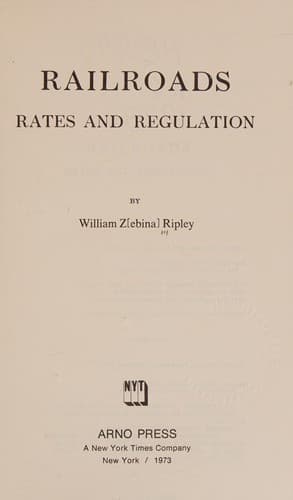
Railroads: Rates and RegulationsRipley, William Zebina
History
Railroads: Rates and Regulations
Ripley, William Zebina
Railroads -- Freight -- Rates -- United States; Railroads and state -- United States
[121] The diverse interests to be reconciled must also include the
lumbering centres once "next the stump," but now placed at a relative
disadvantage. The Eau Claire lumber case [reprinted in Railway
Problems, pp. 203-233] should be read in this connection.
[122] The remarkable rise of the sash, door and blind industry in
the South, as prejudiced by comparison with Chicago under an outworn
schedule of rates, is given in 23 I.C.C. Rep., 110.
[123] On the parity cases, consult Hammond, Railway Rate Theories,
etc., 1911, pp. 120 and 149.
[124] 14 I.C.C. Rep., 1-74 and Ann. Rep. I.C.C., 1911, p. 46. The later
judicial history will be found at p. 543, _infra_.
[125] P. 489, _infra_.
[126] Rates must not vary with profits. 13 I.C.C. Rep., 429; and
consistently held ever since.
[127] Arbitration of Cotton Rates, etc., Nov. 15 and 16, 1900; pamphlet
arguments of Southern v. Illinois Central Railways. Wool rates are the
same. 23 I. C. C. Rep., 151.
[128] This was the gist of the complaint in the Cincinnati Freight
Bureau case; pp. 248, 392 and 588, _infra_.
[129] Chapters XI and XIX, _infra_.
[130] Now covered by law since 1910. Pp. 512 and 571, _infra_.
[131] Pp. 324 and _infra_.
[132] Senate Committee on the Transportation Interests of the United
States and Canada, 1890, p. 362.
[133] 9 Int. Com. Rep., 318; in our Railway Problems, chap. XVII.
[134] Hammond, Railway Rate Theories, etc., 1911, p. 82, cites cases.
[135] Chapter VIII, _infra_.
[136] 5 Int. Com. Rep., 264; in our Railway Problems, chap. VIII.
[137] _Cf._ p. 255 _et seq., infra_.
[138] A carload of bamboo steamer chairs from San Francisco to New York
for $9.40 in the course of a rate war, would seem to be rather below
bed-rock. 21 I. C. C. Rep., 349.
[139] _Quarterly Journal of Economics_, V, 1891, pp. 438-65; reprinted
in Railway Problems, chap. V.
[140] _Cf._ Int. Com. Reports, 1903, p. 436.
[141] The Hepburn Committee testimony in 1879, p. 2893, is eloquent
upon this aspect of the question.
[142] 1st Annual Report, I.C.C., 1888. _Cf._ Strombeck, Freight
Classification, pp. 35-60.
[143] C., N. O. & T. P. case, testimony, vol. II, pp. 332-333.
[144] _Cf._ The Freight Rate Primer, bearing no authors or publishers
name, but largely compiled from addresses by President W. C. Brown of
the New York Central & Hudson River. Similar arguments and computations
occur in the testimony before the Senate (Elkins) Committee of 1905,
pp. 1162 and 2276.
[145] Now who will say that it is unreasonable to charge 7-1/2 cts. to
carry a suit of clothes from Chicago to New York.... Railways could
charge three or four times the cost of transportation for a pair
of drawers and the rates would still be reasonable.... But all the
first-class rates are of that nature.--Albert Fink, testimony, C., N.
O. & T. P. case, p. 290.
[146] Senate (Elkins) Committee, 1905, p. 1162.
[147] In _re_ Proposed Advances in Freight Rates, I.C.C., April 1, 1903.
Public-domain text, read in full here on John Shaqi.
Reviews
Reviews
No reviews yet
Be the first to share your thoughts on this work.
Elsewhere in the archive
Join the Discussion
Join the discussion
Sign in to leave a comment or review.
Sign InorCreate an account