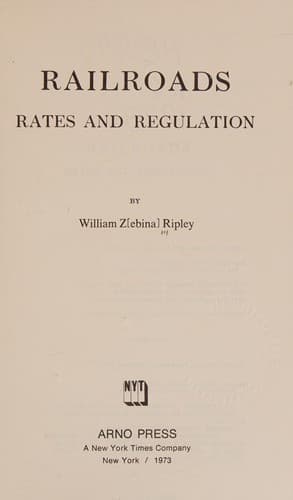
Railroads: Rates and RegulationsRipley, William Zebina
History
Railroads: Rates and Regulations
Ripley, William Zebina
Railroads -- Freight -- Rates -- United States; Railroads and state -- United States
The force of this description of the underlying motive for personal
discrimination, so far as the carrier is concerned; namely to build
up one man at the expense of his competitors and to attach him in
interest indissolubly to the company, is well exemplified in a case
which occurred in 1908 at Galveston, Texas.[162] Practically all
railway traffic entering Galveston was destined for export. Wharfage
facilities were limited to two concerns, one of them being the Southern
Pacific Terminal Co. A uniform charge of one cent per hundredweight for
cotton seed meal and cake passing over the wharves of both companies
had been the rule for a long time. Yet it appeared on complaint that
one merchant had been granted wharfage space under discriminatingly
favorable conditions. Exemption from demurrage charges, free storage
room and other favors and a fixed rental of $15,000 per year
irrespective of the amount of his shipments, had enabled him, having
been in business only since 1898, to build up a very large traffic. The
export of cotton seed cake instead of meal had greatly increased since
1904. The business of all other competitors since this contract was
made had shrunk to insignificant proportions by comparison with that
done by this favored merchant. The margin of profit in the business
was so small that the difference between the charges and privileges
enjoyed by this individual and his competitors, was forcing them all
out of business. It was estimated by the Interstate Commerce Commission
that if the customary wharfage charges had been paid, the rental would
have been nearly $30,000 for the year 1907, irrespective of other
favors. The cotton planters complained also that this monopoly limited
their market and depressed business. It is clear that the larger the
business, that is to say the more nearly it became a monopoly, the
smaller became the wharfage charges per hundredweight under this system
of a fixed rental; and, in consequence, the greater was the disability
of the other shippers. The advantage to the railroad appeared in
a contract entered into, which provided that all traffic for this
individual should be routed over the Southern Pacific or its connecting
lines. As he had practically gathered in all the cotton seed export
business of Texas and the adjoining states within two years, it is
evident that this consideration was of great value to the railroad. The
economic motive in this case and in the one previously cited was the
same. It will be found in fact to underlie almost all cases of personal
favoritism and discrimination.
Public-domain text, read in full here on John Shaqi.
Reviews
Reviews
No reviews yet
Be the first to share your thoughts on this work.
Elsewhere in the archive
Join the Discussion
Join the discussion
Sign in to leave a comment or review.
Sign InorCreate an account