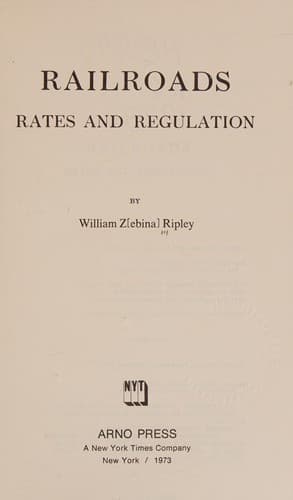
Railroads: Rates and RegulationsRipley, William Zebina
History
Railroads: Rates and Regulations
Ripley, William Zebina
Railroads -- Freight -- Rates -- United States; Railroads and state -- United States
The supreme disadvantage in building up a great monopoly in order to
win traffic for a railroad is, of course, that the moment the shipper
becomes sufficiently powerful, he can play off one road against
another, thus becoming practically master of the situation. Sindbad is
soon overwhelmed by the old man of the sea. And the weaker the road
financially, the more powerful is the appeal, to which at last even the
strongest lines must succumb. The history of the Standard Oil Company
during the eighties clearly exemplifies this. The rapid rise of the
cattle "eveners" yet earlier, until, as the private refrigerator car
companies they controlled the situation, was primarily traceable to the
same causes. The late J. W. Midgly[163] gives a forcible illustration
in the attempt in 1894 of ninety-five railroads to reduce the mileage
allowance paid for use of oil tank cars owned by private companies
from three-fourths to one-half cent per mile, loaded and empty. The
Union Tank Line promptly replied that it would in that event at once
concentrate all its vast tonnage to points north and west of Chicago,
upon the single line--presumably the weakest one--which would continue
the old rate. This argument was irresistible; and in the old days of
unregulated competition was in the nature of things bound to be so.
Careful distinction must be made at this point, between personal
discrimination and general rate cutting. Rebating,--that is to
say, departure from published tariffs,--occurs in both cases. The
difference between the two is that in the one case it is special,
particular and secret; while in the other it is so general, if not
indeed universal, as to be matter of common knowledge. Rebating, in
other words, is a common feature of rate wars. But, on the other hand,
general harmony in the rate situation by no means implies the absence
of personal favoritism. During a wide-open rate war, indeed, the most
iniquitous aspect of rebating,--inequality of treatment as between
rival shippers,--may be quite absent. All may be getting the same
rate, namely a cut rate; although the chances are of course that the
bigger the shipper, the more substantial the concessions offered. It is
important to keep this distinction clear, especially since the railways
have awakened to the losses to themselves attendant upon rate wars.
Public-domain text, read in full here on John Shaqi.
Reviews
Reviews
No reviews yet
Be the first to share your thoughts on this work.
Elsewhere in the archive
Join the Discussion
Join the discussion
Sign in to leave a comment or review.
Sign InorCreate an account