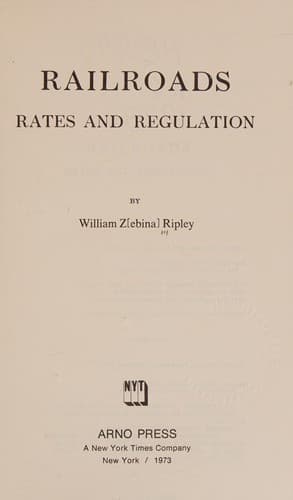
Railroads: Rates and RegulationsRipley, William Zebina
History
Railroads: Rates and Regulations
Ripley, William Zebina
Railroads -- Freight -- Rates -- United States; Railroads and state -- United States
Rebating in the early days consisted in simply refunding by direct
payment to the favored shipper, a certain proportion of the freight
bill. This refund might be in cash, in presents to himself or his
family, in salary allowances to clerks, in free passes, or in free
transportation of other goods. In a recent case in New York it has
taken the form of importer's "commissions." But, since 1887 at least,
an inconvenience in all such transactions is their necessary entry
in some form or other upon the books of the company. Of course such
rebates could be covered up as a fictitious charge to operating
expenses; or, as in the case of the Atchison in 1893, might be
carried as an asset, as if such refunds would ever be paid. Nearly
$4,000,000 was thus entered as padding in Atchison assets, when it
went into a receiver's hands at that time.[165] Much of the flagrant
Standard Oil rebating in the eighties was almost openly, and certainly
boldly, carried on by these means. But public sentiment was always
against it; and of course, it was a breach of good faith as between
the railways themselves, in their endeavor to maintain agreed rates.
Secrecy, therefore, always attaches to these transactions; and the most
ingenious devices were invented to confer favors without detection.
Underclassification of freight was a very common device in the old
days. It has reappeared again since 1907 in much the same form. There
is a great difference between the freight on a keg of nails and of fine
brass hardware or cutlery. Who is to know whether a shipment be billed
as one or the other? Is every box of dry goods to be examined in order
to discover whether it contains silks or the cheapest cotton cloth? A
carload of lumber or cordwood might easily by prearrangement be filled
inside with high grade package freight. The utmost vigilance is in fact
necessary on the part of carriers, to prevent such fraudulent practices
by shippers. Under the Joint Rate Trunk Line Inspection Bureau in 1893,
183,575 such false descriptions or underweighings were detected on
westbound shipments from seaboard cities alone.[166] What the amount
of such Underclassification of freight by collusion between agent and
shipper was, can only be conjectured. Even more difficult to detect was
the practice of under-billing.[167] At a certain time, the rate on
flour from Minneapolis to New York was thirty cents per hundredweight,
divided between connecting roads in the proportion of ten cents from
Minneapolis to Chicago, and twenty cents from there on to destination.
In the meantime, as against this ten cent proportion of the through
rate to New York, the local rate from Minneapolis to Chicago was twelve
and one-half cents. As between two rival shippers, the one sending to
Chicago on a New York through rate instead of a local one, would enjoy
a clear advantage of twenty-five per cent. over his competitor. And
who was to know whether a car billed through to New York, was really
Public-domain text, read in full here on John Shaqi.
Reviews
Reviews
No reviews yet
Be the first to share your thoughts on this work.
Elsewhere in the archive
Join the Discussion
Join the discussion
Sign in to leave a comment or review.
Sign InorCreate an account