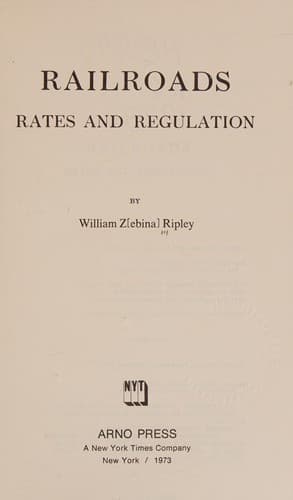
Railroads: Rates and RegulationsRipley, William Zebina
History
Railroads: Rates and Regulations
Ripley, William Zebina
Railroads -- Freight -- Rates -- United States; Railroads and state -- United States
All parties concerned are probably agreed in the hope of eliminating
the rate war forever. But there is not the same evidence of either
an intent or desire on the part of railway officials to get rid of
what, from a public point of view, is even more insidious and unjust;
that is to say, the secret concession of favors to a few chosen large
shippers. General rate wars, as will later appear, are probably a thing
of the past.[164] But secret rebating seems, on the other hand, to be
an evil which must be combatted vigorously and un-intermittently in
order to uproot it as a feature of American industrial life. And of
course it must cease. For it is the most prolific source of evil known
in transportation. It has probably had more to do with the creation
of great industrial monopolies than any other single factor. The first
feature of any reform of our intolerable "trust" situation, must be to
keep the rails open on absolutely even terms to all shippers, large or
small.
The keynote of discrimination is, as we have said, the creation of
monopoly, or, at all events, of so large an aggregation of shipments,
that a profitable partnership between the shipper and the railroad
results. This is clear in recent indictments which charge that the
railroads concerned, having selected one large firm of forwarders in
New York and Chicago are giving them a monopoly in respect of all
imports. In the case of the great beef packers, the railroad having
once built up a shipper by favored rates, may continue in the enjoyment
of this concentrated tonnage with greater security and profit than if
it moved in a multitude of small shipments by numerous competitors. Of
course there is another less common form of rebating which, so far as
its profit is concerned, is limited to the particular dishonest railway
official who arranges the matter. Such favoritism as this, however,
represents a loss to the company; and has always been stamped out by
the carriers when discovered. The principal form above described,
is much more difficult to uproot. And yet for some reason, it is a
distinctively American abuse. European countries seem never to have
suffered from it, to any such degree as has the United States. It is,
as has just been said, perhaps the most iniquitous, the most persistent
and until very recently the most nearly ineradicable evil connected
with the great business of transportation.
Public-domain text, read in full here on John Shaqi.
Reviews
Reviews
No reviews yet
Be the first to share your thoughts on this work.
Elsewhere in the archive
Join the Discussion
Join the discussion
Sign in to leave a comment or review.
Sign InorCreate an account