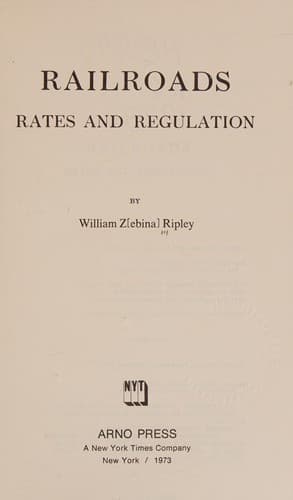
Railroads: Rates and RegulationsRipley, William Zebina
History
Railroads: Rates and Regulations
Ripley, William Zebina
Railroads -- Freight -- Rates -- United States; Railroads and state -- United States
"Investigations made by the Interstate Commerce Commission at
different times have disclosed to some extent the very large
sums received by shippers as mileage for the use of such cars.
"By an investigation made in 1889 it appeared that on a single
line of road between Chicago and an interior Eastern point--a
distance of 470 miles--refrigerator cars owned by three
shipping firms made in nine months, from August 1, 1888, to May
1889, 7,428,406 miles, and earned for mileage $72,945.97, being
about $8,112 a month or substantially at the rate of $100,000 a
year.
"By another investigation, made in 1890, it appeared that
private stock cars to the number of 250 had been used upon
a line made up of two connecting roads between Chicago and
New York, beginning with 150 cars on September 1, 1880,
increased 30 more a month later, 20 more another month later,
and reaching the total of 250 in June, 1890; that the cars
altogether had cost $156,500, and had earned for mileage in
two years, from September 1, 1888, to September 1, 1890,
$205,582.68; that the entire expense to be deducted during that
period for car repairs and salaries for their management was
$34,050.48, leaving net revenue to the amount of $171,532.20,
being an excess of $15,032 above the whole cost of the cars.
The cars were, therefore, paid for and a margin besides in two
years, and, thereafter, under the same management and with a
corresponding use of the cars, an income of upward of $100,000
a year was assured on an investment fully repaid, or, in
effect, on no investment whatever."
By 1903 the railroads were paying over $12,000,000 annually for the use
of such equipment.
With the growth of their power, the extortionate demands of these
private car lines, both upon the railroads and the shipper, steadily
enlarged. From the roads they often compelled fictitious mileage
allowances; and from the shipper the most outrageous charges were made
for icing and other services en route. The reports of the Interstate
Commerce Commission for 1903-1904 and of the Senate (Elkins) Committee
of 1905 deal fully with these abuses. Moreover the Armour company
gradually forced other competitors out of business, and with the growth
of monopoly, its exactions became even more extreme. The following
instance is typical.
Public-domain text, read in full here on John Shaqi.
Reviews
Reviews
No reviews yet
Be the first to share your thoughts on this work.
Elsewhere in the archive
Join the Discussion
Join the discussion
Sign in to leave a comment or review.
Sign InorCreate an account