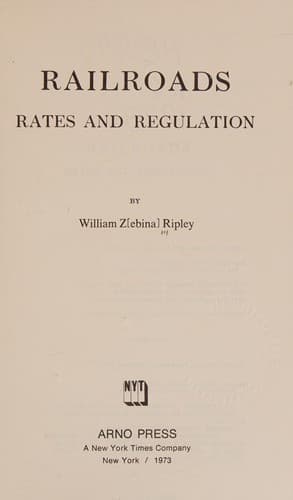
Railroads: Rates and RegulationsRipley, William Zebina
History
Railroads: Rates and Regulations
Ripley, William Zebina
Railroads -- Freight -- Rates -- United States; Railroads and state -- United States
"In 1898 the Armour Car Lines Company was furnishing cars
for the movement of Michigan fruits from points on the Pere
Marquette Railroad to Boston in competition with other private
car companies, and its charge for refrigeration to Boston was
$20 per car. Its present charge to Boston is $55 per car.
Before the present exclusive contract was entered into between
the Armour Car Lines and the Pere Marquette Railroad Company
the actual quantity of ice required was charged for at $2.50
per ton. Under this system the cost of refrigerating cars from
Pawpaw, Mich., to Dubuque, Iowa, averaged about $10 per car,
while the present schedule of the Armour Car Lines is $37.50.
The cost of icing from Mattawan, Mich., to Duluth was $7.50,
as shown by an actual transaction in the year 1902, while the
present refrigeration charge between those points is $45. The
cost of icing pineapples from Mobile to Cincinnati under an
exclusive contract with the Armour Car Lines is $45, while
the cost of performing the same service from New Orleans to
Cincinnati over the Illinois Central is $12.50 per car."
Fortunately the progressive enlargement of Federal powers of
supervision has tended to check these exactions. But the system of
special allowances for the use of privately owned equipment, is one
which needs the most careful watching by the authorities.
With the passage of time, and especially since 1896, new and even more
elaborate schemes for rebating have come to light. One of the most
ingenious, which was discovered about 1904 to be very widespread,
was the use of terminal or spur track railway companies.[173] In
Hutchinson, Kansas, for example, were salt works having a capacity of
some 6000 barrels a day. Two railways were available for shipments.
A new company was incorporated, all its stock being held by the salt
works owners, which constructed sidings to both railroad lines. The
spur track was less than a mile long and cost only about $8000 to
build. But the company was chartered as the Hutchinson and Arkansas
River Railroad. Its officers were the owners of the salt mills.
It owned neither engines nor cars. Yet it entered into a traffic
agreement with the Atchison road for a division of the through rate
to many important points, its share being about twenty-five per cent.
So substantial a pro-rate was this, that in a few months the H. and
A. R. R. received back some fifteen thousand dollars as its share of
the through freight rates. And every dividend declared by it was, of
course in effect a rebate enjoyed exclusively by this particular mill,
as against less favored competitors.
Public-domain text, read in full here on John Shaqi.
Reviews
Reviews
No reviews yet
Be the first to share your thoughts on this work.
Elsewhere in the archive
Join the Discussion
Join the discussion
Sign in to leave a comment or review.
Sign InorCreate an account