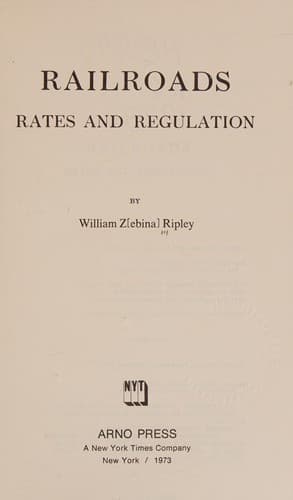
Railroads: Rates and RegulationsRipley, William Zebina
History
Railroads: Rates and Regulations
Ripley, William Zebina
Railroads -- Freight -- Rates -- United States; Railroads and state -- United States
Before dismissing these recent and widely "muck-raked" oil cases,
it may not be out of place to mention the new interpretation of the
Elkins law which has resulted therefrom. One concerns the definition of
separate offences. In the notorious $29,000,000 fine case, the Federal
Circuit judge applied the maximum penalty of $20,000 for each offence
to each separate carload in a large aggregate of shipments. On review
of the case, each separate settlement of freight rates was defined as
the unit of an offence. As entire train loads had been forwarded or
paid for at one time, this materially reduced the aggregate of possible
penalties. And, in the second place, the question of legally provable
intent was raised. The turning point in the $29,000,000 fine case, was
the ruling of the judge on review, that it was necessary to prove that
a standard rate, higher than the one actually paid, had actually been
filed at Washington; and that the defendant had knowingly accepted a
concession from this figure. These points the government was unable in
fact to establish; and this ended the case.[184]
While general rate cutting has been less common since 1900, partly also
because the roads were rapidly forming great combinations especially
in order to eliminate it, subsequent developments have proved that
personal and secret favoritism to large shippers was still very common.
Despite all they could do to withstand pressure, traffic managers
seemed powerless without the aid of the law. Perhaps the greatest
revelation of the extent of personal rebating was afforded by the great
Wisconsin investigation under the leadership of Governor La Follette in
1903.[185] The original purpose of this inquiry was fiscal; namely, to
examine into the subject of railroad taxation. But its scope speedily
widened, and at last skilled accountants were put into the books of all
the railroads traversing Wisconsin.
The facts elicited by the Wisconsin investigation were startling. For
the years 1897-1903, the direct rebates appearing in the accounts of
the Wisconsin lines alone,--taking no account of other forms of rebates
such as excessive damage allowances and the like,--were $7,000,000.
The Chicago and Northwestern alone had allowed more than half of this
amount. And from what is now known of other forms of allowance, the
total must have been indeed very great. In one year recently, there
was evidence to the effect that rebates on the New York Central lines
amounted to $1,000,000. According to its own admission, the Michigan
Central road, in 1902-1903, made allowances of $586,000. The rebating
to the beef packers, especially on export business during 1902, was
notorious. No wonder the progressive railroad leaders desired to put
an end to this leakage of revenue. And at their request, the wise
legislation known as the Elkins Amendments to the Act to Regulate
Commerce was passed in 1903.[186]
Public-domain text, read in full here on John Shaqi.
Reviews
Reviews
No reviews yet
Be the first to share your thoughts on this work.
Elsewhere in the archive
Join the Discussion
Join the discussion
Sign in to leave a comment or review.
Sign InorCreate an account