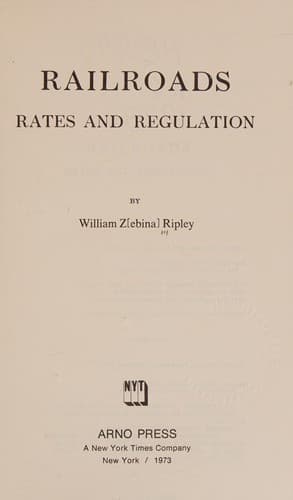
Railroads: Rates and RegulationsRipley, William Zebina
History
Railroads: Rates and Regulations
Ripley, William Zebina
Railroads -- Freight -- Rates -- United States; Railroads and state -- United States
The first serious attempt at railroad operation in the United States
was on the Baltimore & Ohio line in 1830. The company, although
chartered in 1821, did not begin construction for seven years. It was
three years later than this when Peter Cooper's "Tom Thumb" made
a trial run out from Baltimore with a record of thirteen miles per
hour. A road from Albany to Schenectady was opened in 1831; and a
series of connecting links was rapidly pushed westward across New York
state, finally reaching Buffalo in 1842. But prior to 1840, activity
in railroad construction was most noticeable in Pennsylvania: partly
because of its lack of so admirable a water route to connect it with
inland markets as was enjoyed by New York, and partly because of the
growth of the coal business which caused the main lines of the Reading
Railroad to be laid down as early as 1838. The state of Pennsylvania
was busily engaged in improving her existing route over the mountains
by replacing the canal and portage portions with rail lines. Pittsburg,
which formerly had been five and a half days distant, was thus
connected by railroad in 1834. Cars built in the form of boat sections
were to be transferred from the rails to canals along part of this
route. The Pennsylvania Railroad aiming to provide continuous railway
communication over the mountains, was not chartered until 1846; but,
nevertheless, as early as 1835 Pennsylvania had over two hundred miles
of railway, about one-quarter of the mileage of the United States. New
York and New Jersey had about one hundred miles between them, while
South Carolina had one hundred and thirty-seven miles. The Baltimore &
Ohio during this time was being slowly pushed westward; although it did
not reach the Ohio river until 1853, two years after the Erie had, by
liberal state aid, been carried to the lakes at Dunkirk, N.Y. Thus it
appears that during the decade to 1840 railroad building had progressed
unchecked by the panic of 1837. This panic, in fact, by rendering the
state construction of canals impossible, may actually have increased
the interest in railroad building. The railways of this time were still
mainly experimental. They were local and disconnected, serving rather
as supplementary to, than as actual competitors of the existing water
routes. In Massachusetts and Connecticut the lines radiating out from
seaports were intended to serve only as feeders to coastwise traffic;
just as short lines were built along the Great Lakes during the decade
to 1850 to bring products out to a connection with the natural water
routes. A notable exception was the continuous line which by 1840 was
in operation lengthwise of the Atlantic coast plain from New York
south to Wilmington, North Carolina. The Camden and Amboy between
Philadelphia and New York was operated early in the thirties; about the
same time that the Philadelphia, Wilmington & Baltimore was completed.
Much interesting history centres about the first named road. It seems
Public-domain text, read in full here on John Shaqi.
Reviews
Reviews
No reviews yet
Be the first to share your thoughts on this work.
Join the Discussion
Join the discussion
Sign in to leave a comment or review.
Sign InorCreate an account