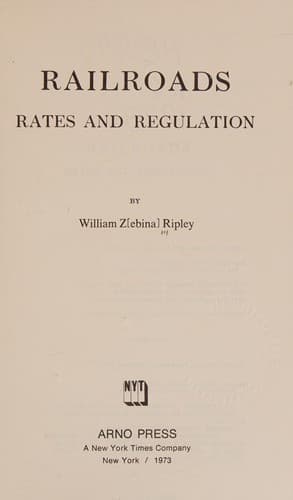
Railroads: Rates and RegulationsRipley, William Zebina
History
Railroads: Rates and Regulations
Ripley, William Zebina
Railroads -- Freight -- Rates -- United States; Railroads and state -- United States
to do at any time; and, however small the net return, it is at least
all gain. On the other hand, when the net return on a large volume of
its natural business becomes unduly small, the financial stability
of the direct line is put in jeopardy. The danger of local rates (as
at X) being actually enhanced or at least prevented from reduction,
because of an unduly low level of competitive rates at more distant
points, is thus much greater when X is a way station on a direct line
than when, as in our first instance, it is an intermediate point on
a roundabout route. For this reason the direct line through X is at
the outset put to a justification of its local tariffs, as to whether
they are inherently reasonable or not; first, by comparison with the
general level throughout the surrounding territory; and, secondly, as
yielding a return on the capital actually invested. This seems to have
been the line of reasoning which the Interstate Commerce Commission
adopted in the recent important Spokane, Washington, cases.[211] The
low through rates to the Pacific coast were established as reasonable
by the competition of sea routes round the Horn, and especially by the
newly-opened Tehuantepec Railroad. The only ground for finding there
was discrimination against Spokane was an inherent unreasonableness in
its rate. This was, in fact, the outcome; the decision being rendered
notable, further, by reason of the prominence given to the valuation of
the railroads' property as a basis of judgment.
Public-domain text, read in full here on John Shaqi.
Reviews
Reviews
No reviews yet
Be the first to share your thoughts on this work.
Elsewhere in the archive
Join the Discussion
Join the discussion
Sign in to leave a comment or review.
Sign InorCreate an account