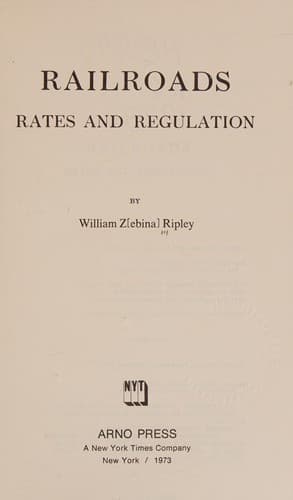
Railroads: Rates and RegulationsRipley, William Zebina
History
Railroads: Rates and Regulations
Ripley, William Zebina
Railroads -- Freight -- Rates -- United States; Railroads and state -- United States
The first important point to be established, then, in this second
variety of the oyster case was as to the relative distribution of
traffic from the more distant competitive point by the several lines
open to it. The next concerned the absolute reasonableness of the rate
at the intermediate point. In the third place, we must inquire whether
the rate at the more distant point may not be unreasonably low. This
was a contingency not possible, as we have just seen, in the Spokane
case. But others may be different in this regard. One is thus forced
to consider the effect of the presence of roundabout competitive lines
upon the level of rates at the more distant point. An indirect rival
road may, as in the St. Cloud case, carry only seventy-three carloads
a day as compared with a daily movement of one thousand cars by the
direct lines. On the other hand, as in the Savannah Freight Bureau
case, Valdosta, Georgia, may receive nine-tenths of its supply of
fertilizer by indirect roads. But in any event it is the potential,
not the actual, movement of tonnage, which may count in the long run.
It is indisputable that the short line between two points never pares
its rates down to an irreducible minimum except under compulsion.
The presence of a roundabout route affords just this pressure to
reduction. Even allowing that in the last analysis the long line will
strike bed-rock of no profit first, it is indisputable that such lines
frequently, instead of merely meeting rates made for them by the direct
routes, seek to divert business by actually undercutting those rates.
Having only a small share of the tonnage, they take risks which would
be fatal to others. To transport at an absolute loss is of course no
more defensible than the argument of the merchant that the only way
to compensate for selling goods below cost was to enlarge the volume
of his business. But, of course, there is always the chance that, by
enlarging this volume sufficiently, operating expenses may be so far
cut down that a loss may be transformed into a profit. The diversion
of enough traffic from the direct railroad line to accomplish this end
would, of course, reduce the volume of its traffic and thereby unduly
burden it, to the manifest injury of all local points like X.
Public-domain text, read in full here on John Shaqi.
Reviews
Reviews
No reviews yet
Be the first to share your thoughts on this work.
Elsewhere in the archive
Join the Discussion
Join the discussion
Sign in to leave a comment or review.
Sign InorCreate an account