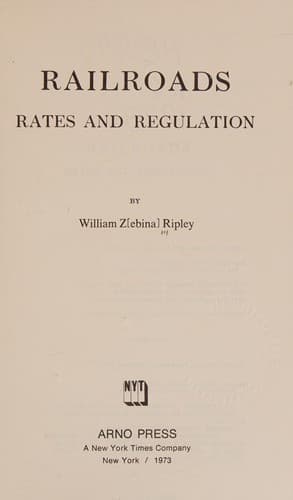
Railroads: Rates and RegulationsRipley, William Zebina
History
Railroads: Rates and Regulations
Ripley, William Zebina
Railroads -- Freight -- Rates -- United States; Railroads and state -- United States
invoked; so that a well planned system of railroads resulted even as
early as 1843. The South Carolina Railroad between 1829 and 1833 most
successfully operated a pioneer line, its securities being quoted at
twenty-five per cent. above par. The Charleston & Hamburg line opened
in 1833, one hundred and thirty-seven miles long, was said to be the
largest system under one management in the world. Augusta & Columbia
were linked up with the coast. Savannah also penetrated inland to the
Piedmont belt by a line finished in 1843 as far as Macon. The interest
in a through route to connect Cincinnati and Louisville with Charleston
was very keen; and had it not been for the tremendous fall in cotton
prices in 1839-1840, the project might have succeeded. As it was, a
great railroad convention at Knoxville in 1836 was attended by no
less than four hundred delegates from nine different states. It was
not so much the mileage of these roads which rendered them notable,
as the fact of their intended reliance upon through freight instead
of passenger business. Roads in other parts of the country were as
yet depending in the main upon passenger traffic or upon the carriage
of what we would now call local or parcel freight. These southern
lines were built to accommodate traffic in great staple agricultural
products--cotton out and foodstuffs in. Unlike the northern roads,
also, they early adopted a uniform gauge and sought to promote long
distance business. Later developments in the South especially in the
direction of improved service were very slow. The northern states
speedily outstripped them; but the enterprise of this region in
railroad building and operation at the outset has not been fully
appreciated.
Public-domain text, read in full here on John Shaqi.
Reviews
Reviews
No reviews yet
Be the first to share your thoughts on this work.
Join the Discussion
Join the discussion
Sign in to leave a comment or review.
Sign InorCreate an account