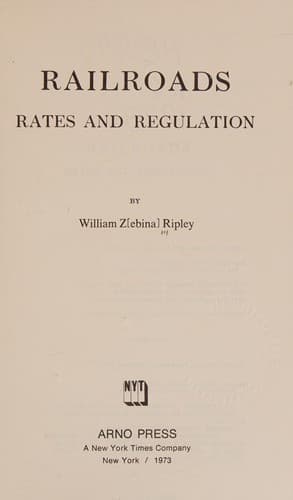
Railroads: Rates and RegulationsRipley, William Zebina
History
Railroads: Rates and Regulations
Ripley, William Zebina
Railroads -- Freight -- Rates -- United States; Railroads and state -- United States
local rates, cutting them drastically, but leaving the northern
locals unchanged. This decision was never carried into effect; as
the Supreme Court of the United States held the Commission to have
no such rate-making power. Nothing was done apparently to remedy the
disparity in charges against the West, although the railroads serving
that territory urgently pressed for action. Every time they threatened
a reduction of their western rates, the eastern line came down in
proportion. This left the relative rates as before, although the
general scale would be lower all round.
At last, in 1905, the eastern lines from Baltimore south agreed to
permit a reduction of five cents in the rates from western cities by
lines _north_ of the Ohio river; but they refused to accede to any
change in the rates from the Ohio south. This was the exact opposite
of the Interstate Commerce Commission's proposition, although both
plans were intended to compass the same object; namely, to place
western shippers more nearly on a parity with the East. The Commission,
in 1894, laid all reduction upon the southern portion of the rate;
the railroads, in 1905, placed it all upon the northern part. This
obviously afforded no relief to the original complainant, Cincinnati.
In fact, it actually operated to its great disadvantage, inasmuch as it
let its two powerful rivals, Chicago and St. Louis, into the southern
field on distinctly more favorable terms. Such was the outcome as a
result of the friction of railroad competition. The reasonableness of
some reduction was clear. But to the layman, the fairness of laying the
reduction entirely upon the northern locals, already relatively low,
instead of upon the extremely high southern part of the rate is not by
any means so clear.[234]
One further detail of this adjustment of southern rates raises a
question:
"Rates between Richmond, Virginia, and Atlanta, Georgia, are
less than the rates between Richmond, Virginia, and Greenwood,
South Carolina (an intermediate point). This is due to
indirect competition between Richmond and Western jobbing
points; and in order to permit the jobber or manufacturer
in Richmond to do business as against his competitor in
Cincinnati, it has been necessary to fix the rates from
Richmond to Atlanta with some reference to the rates from
Cincinnati to Atlanta. At Greenwood, South Carolina, we find
that the Cincinnati shipper pays a very much higher rate than
to Atlanta, and that the rates from Richmond are already
sufficiently low to enable the Richmond shipper to compete at
Greenwood with the Cincinnati shipper."[235]
Public-domain text, read in full here on John Shaqi.
Reviews
Reviews
No reviews yet
Be the first to share your thoughts on this work.
Elsewhere in the archive
Join the Discussion
Join the discussion
Sign in to leave a comment or review.
Sign InorCreate an account