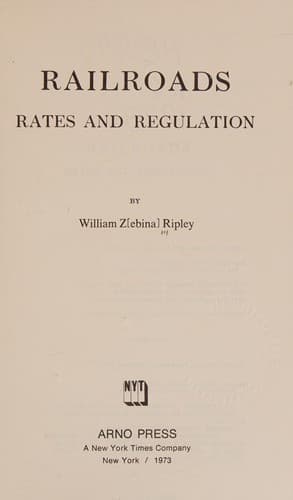
Railroads: Rates and RegulationsRipley, William Zebina
History
Railroads: Rates and Regulations
Ripley, William Zebina
Railroads -- Freight -- Rates -- United States; Railroads and state -- United States
Is this not in a measure well described in the passage, "unto him that
hath shall be given; but from him that hath not, shall be taken away
even that which he hath"? This railway argument contains dangerous
possibilities. In effect, upon the theory of charging what the traffic
will bear, it means that a railway (in this case the Seaboard Air
Line) may increase its own local rates, not in proportion to the
length of its own haul (from Richmond to Greenwood), but according
to the remoteness of that local point from another competing market.
The inevitable effect of the general adoption of such a policy must
be to erect arbitrary barriers to the free and widespread movement
of commerce. The great advantage of the flat rate or of commodity
rates is that, placing all competing centres upon an absolute parity
irrespective of distance, they encourage the utmost freedom of trade.
* * * * *
Certain general conclusions seem to be warranted by the analysis
of these cases of local discrimination. The first is that they all
show the extreme delicacy of commercial adjustment and the existence
of conditions well beyond the control of the carriers, jointly or
singly. Trade jealousies in particular--the rivalry of producing and
consuming centres--render relativity of rates of paramount importance
to shippers. This class in the community is interested comparatively
little in the absolute level of rates, that being more directly the
concern of the general consuming public. To the public, as represented
by State and Federal legislatures, it is difficult to make these
complicated matters of commercial competition clear. The only basis
of rate making that is easily understood is one founded in general
upon the distance principle, or, in other words, correlated with
considerations of cost of operation. Any departure from this basis is
apt to breed suspicion, and at all events puts the carrier upon the
defence. It is bad policy, in their own interest, for railroads to
permit a continuance of such violations of the distance principle in
their general tariffs (commodity rates as a special resource to meet
the special needs of commercial competition may be set aside), except
in extreme cases. This was recognized by the trunk lines when they
almost unanimously acquiesced in the long and short haul provisions of
the Act of 1887. The people of the United States have the same right
that they had then, to expect that at the earliest possible moment
the wise provisions of the trunk line rate adjustment shall be widely
accepted in the West and South. Whether those regions, and the railways
that reach them, have yet sufficiently developed to warrant the change
is a matter requiring careful consideration in detail.
Public-domain text, read in full here on John Shaqi.
Reviews
Reviews
No reviews yet
Be the first to share your thoughts on this work.
Elsewhere in the archive
Join the Discussion
Join the discussion
Sign in to leave a comment or review.
Sign InorCreate an account