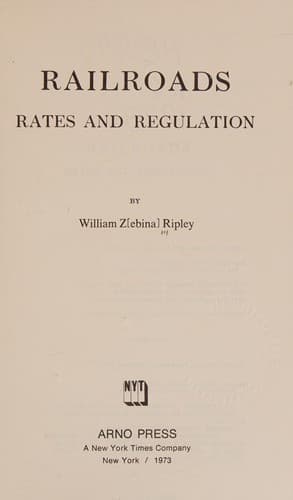
Railroads: Rates and RegulationsRipley, William Zebina
History
Railroads: Rates and Regulations
Ripley, William Zebina
Railroads -- Freight -- Rates -- United States; Railroads and state -- United States
In the case of competition between a direct and a longer, more
roundabout line, which one "controls" or fixes the rate? It is an
important matter, involving as it does the economic, if not the legal,
right of a carrier to participate in any given traffic. Concerning this
question the greatest diversity of opinion prevails. On the one hand,
both writers[239] and practical railway men[240] aver that the short
line makes the rate, while the long line merely meets the rate thus
made. This is probably the more prevalent opinion. Yet expert evidence
of an opposite sort is to be had for the seeking. The Interstate
Commerce Commission has repeatedly held that the short line is at
the mercy of the longer line under certain circumstances;[241] and
traffic managers not infrequently plead their inability to control rate
situations in the face of irrepressible, roundabout competition.[242]
There is evidently a confusion of thinking, or else a loose use of
terms where statements are so conflicting. As a matter of voluntary
agreement among roads, or of prescribed rates under government
regulation, the issue often assumes the form of controversy as to
whether a road operating under a physical disability shall be permitted
to participate in a given business by a concession in rates or not.
Thus in the notable Milk Rate cases it was a question whether roads
with heavy grades should be allowed to make concessions in rates. This
issue really also underlies the question of enforcement of the long
and short haul clause. In the recent Spokane case the Harriman lines to
St. Paul asked that they, being long lines, should not be compelled to
reduce their rates to the figure prescribed for the direct Hill roads.
It is clear in the first place that "short line" and "long line" are
merely used as convenient terms to designate differences in the cost
of operation. This was well put by James J. Hill before the Elkins
Committee of 1905.
"We will say that the distance from Cincinnati to New York is
800 miles, and that they haul 800 tons behind one locomotive
on one per cent. ruling grades. Now somebody else builds a
road with a 0.3 grade, and he can haul 2,000 tons--twice and
a half the amount; but that line is 200 miles longer. You can
see readily that to move a given number of tons the second road
runs less than half the train miles, so that the farthest way
round is the nearest way home in that case."
Public-domain text, read in full here on John Shaqi.
Reviews
Reviews
No reviews yet
Be the first to share your thoughts on this work.
Elsewhere in the archive
Join the Discussion
Join the discussion
Sign in to leave a comment or review.
Sign InorCreate an account