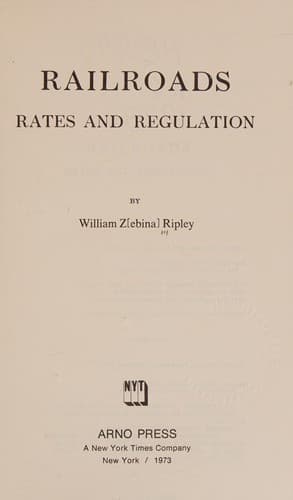
Railroads: Rates and RegulationsRipley, William Zebina
History
Railroads: Rates and Regulations
Ripley, William Zebina
Railroads -- Freight -- Rates -- United States; Railroads and state -- United States
The necessity of some exercise of governmental control over these
carriers of the country, in order to mitigate, if not to eliminate,
local discrimination as far as possible, is evident. Many of the
instances previously cited have clearly shown how impossible it
often is for any railroad, single-handed, to deal with an involved
situation in a large way. Take the Cincinnati Freight Bureau case, for
instance. Conceding, as many would, the claim of western cities to some
readjustment of tariffs in their favor, is it not an anomaly that the
lines south from Baltimore, several hundred miles away, should finally
dictate the means to be employed to remedy the situation at Cincinnati
and Chicago? Who else but the Federal government could ever hope to
disentangle the almost hopeless snarl of competition involved in the
controversy over differentials to and from the Atlantic seaboard?[236]
This controversy is at bottom one of local discrimination. And yet
how is the Interstate Commerce Commission to aid in the solution of
these intricate problems under present conditions? Its hands formerly
doubly tied, are now in part freed by rehabilitation of the long and
short haul clause. But it cannot yet deal with minimum rates, nor is
it clear that it can prescribe differential rates.[237] True, the
commission may, in some cases, accomplish by indirection its purpose of
establishing a proper relativity between rates through the exercise of
its newly granted power to fix maximum rates. This, as we shall see,
was done in the recent Spokane and Denver decisions. Holding that the
charges at interior points were out of line with through rates to the
Pacific coast; and being unable to govern the long-distance tariffs,
it simply ordered a reduction of certain rates at Spokane and Denver
as inherently unreasonable. This solution is not, however, always
practicable. Not infrequently the lower rate at the remoter point will
drop as soon as the intermediate rate is lowered. Thus the former
relativity of charges is re-established on a generally lower scale. The
complaint in the Eau Claire lumber case required the exercise of such
power over minimum rates, in order to remove the disability against a
particular centre. And then, finally, it is indubitable that commercial
competition as a "compelling" factor has been somewhat over-emphasized
by the railroads. Too often conditions in part brought about by
themselves, or in which at least they have acquiesced, have been set up
as a defence for rates favoring certain points. This is especially true
of the southern basing point cases.[238] Whether any further grant of
powers to the Interstate Commerce Commission by Congress is necessary
at this time in order to enable progress to be made in this connection,
it is as yet too soon to predict. The course of affairs for the next
few years will at all events bear attentive watching.
* * * * *
Public-domain text, read in full here on John Shaqi.
Reviews
Reviews
No reviews yet
Be the first to share your thoughts on this work.
Elsewhere in the archive
Join the Discussion
Join the discussion
Sign in to leave a comment or review.
Sign InorCreate an account