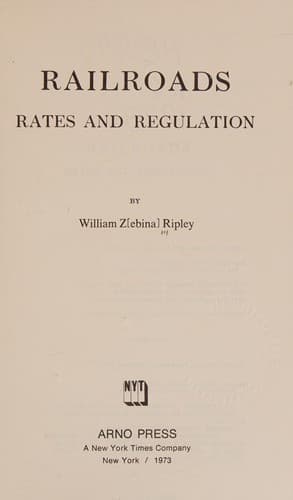
Railroads: Rates and RegulationsRipley, William Zebina
History
Railroads: Rates and Regulations
Ripley, William Zebina
Railroads -- Freight -- Rates -- United States; Railroads and state -- United States
territory and tonnage are more definitely circumscribed by physical
conditions of location.
A point to be noted in this same connection is the relative stability
of the traffic. Is it concentrated in a few hands or does it arise
from many scattered sources? In the former case either road by making
a bold stroke may so entirely capture the business that, by reason
of the enhanced volume, a handicap in operation may be overcome.
Thus, in the notable instance of trunk line competition for the beef
traffic some twenty years ago, the Grand Trunk, although much more
roundabout, besides being handicapped in other ways, by securing
_all_ the business, could afford to make rates impossible under other
circumstances.
Whether the business in question is natural or normal to a road, or
is an extra, diverted from other more direct lines, is still another
factor of importance affecting ability to compete successfully for any
given traffic. The best statement of this is found in the argument
of J. C. Stubbs before the Arbitration Board on Canadian Pacific
Differentials in 1898.[248] "These are differentials in favor of
weaker lines--lines which upon the merits of their service cannot
successfully compete for the business, but claim a share of it as the
reward of virtue, the price of maintaining reasonable rates.... For
example, the Canadian Pacific road was not projected or built for
the purpose of developing, fostering, or sharing the carrying trade
between San Francisco and the eastern part of the United States....
After they were built and the various connections made, then, and not
until then, it was seen that there was a business opened. The route
having been opened, the newer and longer lines entered the field of
competition against the older, shorter, and more direct lines by
cutting the latter's rates.... In a fight of this kind, paradoxical
as it may seem, the stronger line always got the worst of it.... The
weaker or longer line, not having any business at the outset, had
nothing to lose. Everything was gain to it, which appeared to show
an earning above the actual cost of handling the particular lot of
freight. Quite a distinction between that and the average cost of
handling all business. Such an unequal warfare could not long continue,
and the common result was that the stronger line sought for terms, and
ultimately bought the weaker line off, ... this class of differentials
is and always has been obnoxious."
Public-domain text, read in full here on John Shaqi.
Reviews
Reviews
No reviews yet
Be the first to share your thoughts on this work.
Elsewhere in the archive
Join the Discussion
Join the discussion
Sign in to leave a comment or review.
Sign InorCreate an account