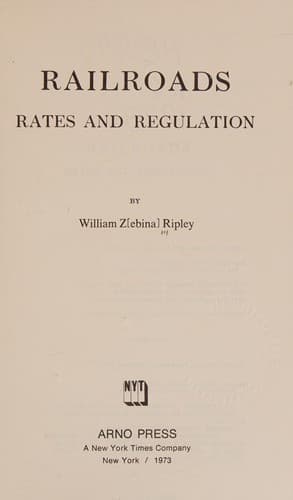
Railroads: Rates and RegulationsRipley, William Zebina
History
Railroads: Rates and Regulations
Ripley, William Zebina
Railroads -- Freight -- Rates -- United States; Railroads and state -- United States
Our final conclusion must therefore be that the outcome in cases of
unequal competition in respect of cost of operation can seldom be
predicted with certainty. Everything depends upon local circumstances
and conditions. Sometimes the long line and sometimes the short line
will dominate. Careful analysis of every feature of the business
must be made before positive affirmation is possible. This result is
at all events worth noting. A due appreciation of the complexity of
the business of rate making may safeguard us against the cocksure
statements of the novice, who has never closely examined into the
subject. President Taft has recently emphasized the need of expert
service in the field of customs and tariff legislation. It is greatly
to be hoped that a similar appreciation of the care with which railway
legislation should proceed may prevail at Washington during the present
session of Congress.
FOOTNOTES:
[200] Cullom Committee, Report, Testimony, p. 532. _Cf._ instances in
Hudson's Railways and the Republic; and Parson's Heart of the Railway
Problem as showing popular misunderstanding.
[201] Senate (Elkins) Committee Report, 1905, p. 1892.
[202] Pp. 116-117.
[203] Another instance is afforded by the Savannah Freight Bureau case:
7 Int. Com. Rep., 458. See our Railway Problems, chap. XII.
[204] Interstate Commerce Commission Reports, decided May 14, 1903.
_Cf._ the extraordinary diversion of traffic over the long route in
Troy-Chatham, N. Y. case: 23 I. C. C. Rep., 263.
[205] This recalls Traffic Manager Bird's testimony relative to
Wisconsin controversies before the Senate (Elkins) Committee, 1905.
[206] Using this term technically as described on p. 256, _infra_.
[207] Chapter XIV, p. 480, _infra_. The original correspondence setting
forth these conditions is reprinted by the Senate (Elkins) Committee,
1905, Digest, App. III, p. 46. 21 I. C. C. Rep., 64, and 17 _Idem_, 335
are analogous cases.
[208] 7 Int. Com. Rep., 458: reprinted in our Railway Problems, chap.
XII.
[209] Brief of Ed. Baxter, Alabama Midland Railway case, U. S. Supreme
Court, p. 71; and Acworth, p. 83. Details in chap. XIV and XIX, _infra_.
[210] 14 I. C. C. Rep., 299.
[211] Details at pp. 245 and 610, _infra_.
[212] Interstate Commerce Reports, No. 696, decided June 25, 1904.
[213] _Cf._ the opinion in the Savannah Fertilizer case in our Railway
Problems, chap. XII.
[214] Chapter XI, _infra_, also in volume II.
[215] 10 Int. Com. Rep., 111; reprinted in full in our Railway
Problems, chap. X. Also the Commerce Court decision in chap. XVI,
_infra_.
[216] The leading Wichita cases are as follows: 9 I.C.C. Rep., 507, 534
and 558.--10 _Idem_, 460. (Lehmann Higginson Co.).--13 _Idem_, 389.
Also 189 U. S. Rep., 274.--Also Senate (Elkins) Committee, 1905, IV. p.
2874 _et seq._
[217] Chapter XVIII, p. 590, _infra_.
[218] 8 Int. Com. Rep., 346; reprinted in full in our Railway Problems,
chap. XI.
[219] Chapter X, _infra_.
[220] Chapter IV, _supra_, p. 128.
Public-domain text, read in full here on John Shaqi.
Reviews
Reviews
No reviews yet
Be the first to share your thoughts on this work.
Elsewhere in the archive
Join the Discussion
Join the discussion
Sign in to leave a comment or review.
Sign InorCreate an account