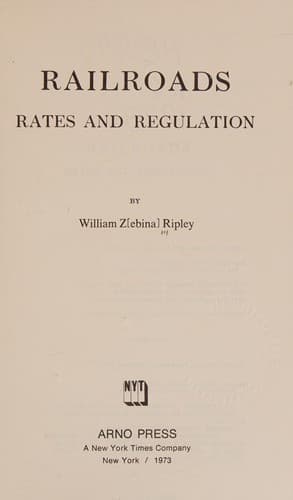
Railroads: Rates and RegulationsRipley, William Zebina
History
Railroads: Rates and Regulations
Ripley, William Zebina
Railroads -- Freight -- Rates -- United States; Railroads and state -- United States
[246] 19 I.C.C. Rep., 218 affords an excellent example as between the
Union Pacific and the Denver and Rio Grande. Also the Montgomery, Ala.,
case in the Commerce Court, p. 590, _infra_. Also the Union Pacific
Merger case, Brief of Facts for Appellants, 1912, p. 276.
[247] For an instance in the tobacco business: _Cf. The Atlantic
Monthly_, 1908, p. 487.
[248] Page 72.
CHAPTER VIII
PROBLEMS OF ROUTING
Neglect of distance, an American peculiarity, 264.--Derived
from joint cost, 265.--Exceptional cases, 265.--Economic
waste in American practice, 268.--Circuitous
rail carriage, 269.--Water and rail-and-water
shipments, 273.--Carriage over undue distance, 277.--An
outcome of commercial competition, 278.--Six causes
of economic waste, illustrated, 280.--Pro-rating
and rebates, 281.--Five effects of disregard
of distance, 288.--Dilution of revenue per ton
mile, 289.--Possible remedies for economic
waste, 292.--Pooling and rate agreements, 293.--The long
and short haul remedy, 295.
The general acceptance, both in practice and theory, of the principle
that distance is a relatively unimportant element in rate making[249]
is significant at this time, in connection with the recent amendment
of the Act to Regulate Commerce. It is important also because of the
marked tendency toward the adoption by various state legislatures of
the extreme opposite principle of a rigid distance tariff. The old
problem of effecting a compromise between these two extreme theories
by some form of long and short haul clause--the original section 4 of
the act of 1887 having been emasculated by judicial interpretation--is
again brought to the front. For these reasons it may be worth while
to consider certain results which inevitably follow the widespread
acceptance of this principle of the blanket rate. Its benefits are
indeed certain; namely, an enlargement of the field of competition, and
an equalization of prices over large areas, and that too at the level
of the lowest or most efficient production. But these advantages entail
certain consequences--of minor importance, perhaps, but none the less
deserving of notice.
Public-domain text, read in full here on John Shaqi.
Reviews
Reviews
No reviews yet
Be the first to share your thoughts on this work.
Elsewhere in the archive
Join the Discussion
Join the discussion
Sign in to leave a comment or review.
Sign InorCreate an account