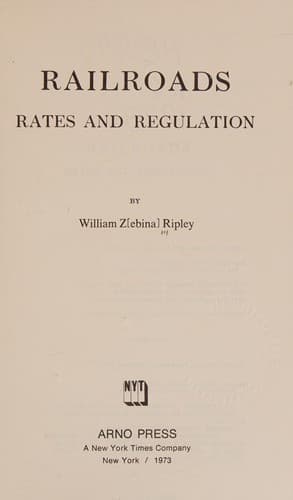
Railroads: Rates and RegulationsRipley, William Zebina
History
Railroads: Rates and Regulations
Ripley, William Zebina
Railroads -- Freight -- Rates -- United States; Railroads and state -- United States
The subordination of distance to other factors in rate making is a
logical derivation from the theory of joint cost. This theory justifies
the classification of freight, namely, a wide range of rates nicely
adjusted to what the traffic in each particular commodity will bear,
while always allowing each to contribute something toward fixed and
joint expenses. In the same way it explains a close correlation of
the distance charge to what each commodity will bear. It assumes
that any rate, however low, which will yield a surplus over expenses
directly incidental to the increment of traffic and which thus
contributes something toward indivisible joint costs, serves not
only the carrier by increasing his gross revenue, but at the same
time lightens the burden of fixed expenses upon the balance of the
traffic. This principle of joint cost, so clearly set forth by
Professor Taussig,[250] is fundamental and comprehensive. It pervades
every detail of rate making. But it rests upon two basic assumptions
which, while generally valid, are not universally so. In the first
place each increment of traffic must be new business, not tonnage
wrested from another carrier and offset by a loss of other business
to that competitor. And secondly, each increment of traffic must be
_economically suitable_ to the particular carriage in contemplation.
The first of these assumptions fails wherever two carriers mutually
invade each other's fields or traffic. Each is accepting business at
a virtual loss, all costs including fixed charges on capital being
taken into account, in order to secure the increment of business. Each
gain is offset by a corresponding loss. It is the familiar case of
the rate war. A less familiar aspect of the matter is presented when
traffic is disadvantageously carried by two competing roads, each
diverting business from its natural course over the other's line. The
sum total of traffic is not increased. Each carries only as much as
before but transports its quota at an abnormal cost to itself. This
may, perhaps, swell gross revenues; but by no process of legerdemain
can the two losses in operating cost produce a gain of net revenue to
both. And each increase of _unnatural_ tonnage, where offset by a loss
of natural business, instead of serving to lighten the fixed charges,
becomes a dead weight upon all the remaining traffic. The commonest
exemplification of this is found in the circuitous transportation of
goods, instances of which will be given later.
Public-domain text, read in full here on John Shaqi.
Reviews
Reviews
No reviews yet
Be the first to share your thoughts on this work.
Elsewhere in the archive
Join the Discussion
Join the discussion
Sign in to leave a comment or review.
Sign InorCreate an account