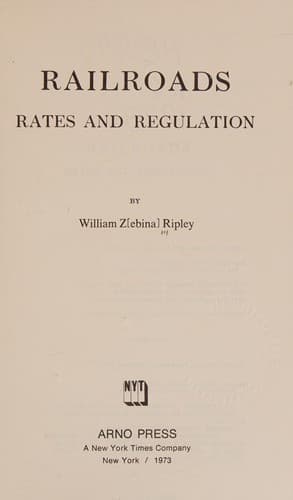
Railroads: Rates and RegulationsRipley, William Zebina
History
Railroads: Rates and Regulations
Ripley, William Zebina
Railroads -- Freight -- Rates -- United States; Railroads and state -- United States
"The more they scatter the better it is for the
railroads." "Keep everyone in business everywhere." And if necessary
to give a fillip to languishing competition, do so by a concession in
rates. Is there not danger that with a host of eager freight solicitors
in the field, and equally ambitious traffic managers in command, a good
thing may be overdone, to the disadvantage of the railway, the shippers
and the consuming public?
An objection to this chain of reasoning arises at this point. Why need
the public or other shippers be concerned about the railways' policy
in this regard? Is not each railway the best judge for itself of the
profitableness of long-distance traffic? Will it not roughly assign
limits to its own activities in extending business, refusing to make
rates lower than the actual incidental cost of operation? And are not
all low long-distance rates, in so far as they contribute something
toward joint cost, an aid to the short haul traffic? The answer will in
a measure depend upon our choice between two main lines of policy; the
one seeking to lower _average_ rates, even at the expense of increasing
divergence between the intermediate and the long distance points, the
other policy seeking, _not so much lower rates as less discriminatory
rates_ between near and distant points. In the constant pressure for
reduced rates in order to widen markets it is not unnatural that the
intermediate points, less competitive probably, should be made to
contribute an undue share to the fixed sum of joint costs. The common
complaint today is not of high rates but of relative inequalities as
between places. It is a truism to assert that it matters less to a
shipping point what rate it pays than that its rate, however high,
should be the same for all competing places. This immediately forces
us to consider the consumer. What is the effect upon the general level
of prices of the American policy of making an extended market the
touchstone of success, irrespective of the danger of wastes arising
from overlapping markets? That the result may be a general tax upon
production is a conclusion with which we shall have later to do. Such
a tax, if it exists, would go far to offset the profit which unduly
low freight rates in general have produced. In short, the problem is
to consider the possible net cost to the American people of our highly
involved and most efficient transportation system. Our markets are
so wide, and our distances so vast, that the problem is a peculiarly
American one.
Public-domain text, read in full here on John Shaqi.
Reviews
Reviews
No reviews yet
Be the first to share your thoughts on this work.
Elsewhere in the archive
Join the Discussion
Join the discussion
Sign in to leave a comment or review.
Sign InorCreate an account