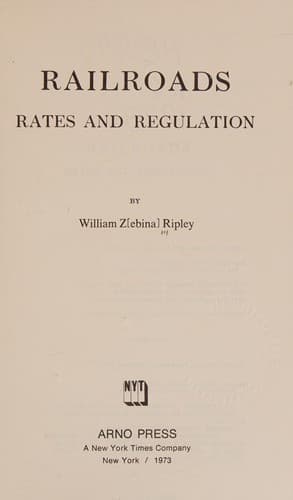
Railroads: Rates and RegulationsRipley, William Zebina
History
Railroads: Rates and Regulations
Ripley, William Zebina
Railroads -- Freight -- Rates -- United States; Railroads and state -- United States
The second case in which the principle of joint cost fails to justify
charges fixed according to what the traffic will bear may arise in the
invasion of two remote markets by one another; or, as it might be more
aptly phrased, in the overlapping of two distant markets. A railroad
is simultaneously transporting goods of like quality in opposite
directions. Chicago is selling standard hardware in New York, while
New York is doing the same thing in Chicago. Prices are the same in
both markets. Of course if the two grades of hardware are of unequal
quality, or if they are like goods produced at different cost, an
entirely distinct phase of territorial competition is created. But we
are assuming that these are standard goods and that there are no such
differences either in quality or efficiency of production. What is the
result? Is each increment of business to the railroad a gain to it
and to the community? The goods being produced at equal cost in both
places, the transportation charge must be deducted from profits. For it
is obvious that the selling price cannot be much enhanced. The level of
what the traffic will bear is determined not, as usual, by the value of
the goods but by other considerations. The traffic will bear relatively
little, no matter how high its grade. The result is that the carrier,
in order to secure the tonnage, must accept it at a very low rate,
despite the length of the haul.
This is the familiar case of the special or commodity rate granted to
build up business in a distant market. Special rates confessedly form
three-fourths of the tonnage of American railways, as has already been
said. The assumption is usually made that such traffic is a gain to
the railways, justified on the principle of joint cost as already
explained. But does it really hold good in our hypothetical case? There
is a gain of traffic in both directions, to be sure. But must it not
be accepted at so low a rate that it falls perilously near the actual
operating cost? It is possible that even here it may add something to
the carriers' revenue, and thereby lighten the joint costs in other
directions. But how about the community and the shipping producers?
Are any more goods sold? Perhaps the widened market may stimulate
competition, unless that is already keen enough among local producers
in each district by itself. The net result would seem to be merely that
the railroads' gain is the shippers' loss. There is no addition to, but
merely an exchange of, place values. Both producers are doing business
at an abnormal distance under mutually disadvantageous circumstances.
It may be said, perhaps, that the situation will soon correct itself.
If the freight rates reduce profits, each group of producers will
tend to draw back from the distant field. This undoubtedly happens in
many cases. But the influence of the railway is antagonistic to such
withdrawal. It is the railway's business to widen, not to restrict,
the area of markets.
Public-domain text, read in full here on John Shaqi.
Reviews
Reviews
No reviews yet
Be the first to share your thoughts on this work.
Elsewhere in the archive
Join the Discussion
Join the discussion
Sign in to leave a comment or review.
Sign InorCreate an account