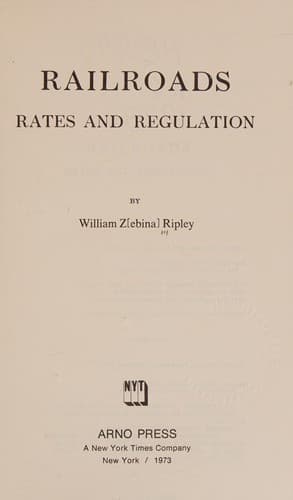
Railroads: Rates and RegulationsRipley, William Zebina
History
Railroads: Rates and Regulations
Ripley, William Zebina
Railroads -- Freight -- Rates -- United States; Railroads and state -- United States
pro-rates with the Minneapolis and St. Louis, the two forming two sides
of a triangular haul. An interesting suggestion of the volume of this
indirect routing is afforded by the statistics of merchandise shipped
between American points which passes through Canada in bond.[263] The
evidence of economic waste is conclusive.
[Illustration]
A common form of wastefulness in transportation arises when freight
from a point intermediate between two termini is hauled to either one
by way of the other. Such cases are scattered throughout our railroad
history. One of the delegates to the Illinois Constitutional Convention
of 1870, cites, as an instance of local discrimination, the fact that
lumber from Chicago to Springfield, Illinois, could be shipped more
cheaply by way of St. Louis than by the direct route.[264] And now a
generation later, it appears that grain from Cannon Falls, forty-nine
miles south of St. Paul on the direct line to Chicago, destined for
Louisville, Kentucky, can be hauled up to St. Paul on local rates and
thence on a through billing to destination, back over the same rails,
considerably cheaper than by sending it as it should properly go.[265]
The Hepburn Committee reveals shipments from Rochester, New York, to
St. Louis, Minneapolis or California, all rail, on a combination of
local rates to New York and thence to destination.[266] Presumably the
freight was hauled three hundred miles due east and then retraced the
same distance; as New York freight for southern California is today
hauled to San Francisco by the Southern Pacific and then perhaps three
hundred miles back over the same rails. Even if the rate must be based
on a combination of low through rates and higher local rates, it seems
a waste of energy to continue the five or six hundred miles extra haul.
Yet the practice is common in the entire western territory. From New
York to Salt Lake City by way of San Francisco is another instance in
point.[267] Of course a short haul to a terminal to enable through
trains to be made up presents an entirely different problem of cost
from the abnormal instances above mentioned.[268]
Public-domain text, read in full here on John Shaqi.
Reviews
Reviews
No reviews yet
Be the first to share your thoughts on this work.
Elsewhere in the archive
Join the Discussion
Join the discussion
Sign in to leave a comment or review.
Sign InorCreate an account