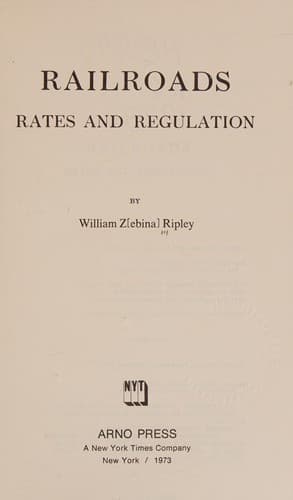
Railroads: Rates and RegulationsRipley, William Zebina
History
Railroads: Rates and Regulations
Ripley, William Zebina
Railroads -- Freight -- Rates -- United States; Railroads and state -- United States
Carriage by water is so much cheaper and as compared with land
transportation is subject to such different rate-governing principles,
that it deserves separate consideration. Mere distance, as has already
been said, being really only one element in the determination of cost,
a circuitous water route may in reality be more economical than direct
carriage overland. Yet beyond a certain point, regard being paid to
the relative cost per mile of the two modes of transport, water-borne
traffic may entail economic wastes not incomparable to those arising
in land transportation. In international trade, entirely confined
to vessel carriage, a few examples will suffice for illustration.
Machinery for a stamp mill, it was found, could be shipped from
Chicago to San Francisco by way of Shanghai, China, for fifteen cents
per hundredweight less than by way of the economically proper route.
Were the goods ever really sent by so indirect a route?[269] It would
appear so when wheat may profitably be carried from San Francisco to
Watertown, Massachusetts, after having been taken to Liverpool, stored
there, reshipped to Boston, thereafter, even paying the charges of a
local haul of nearly ten miles;[270] or when shipments from Liverpool
to New York may be made _via_ Montreal to Chicago, and thence back to
destination.[271] I am credibly informed that shipments of the American
Tobacco Company from Louisville, Kentucky, to Japan used commonly to go
_via_ Boston. Denver testimony is to the effect that machinery, made
in Colorado, shipped to Sydney, Australia, can be transported _via_
Chicago for one-half the rate for the direct shipment; and that on
similar goods even Kansas City could ship by the carload considerably
cheaper by the same roundabout route. Conversely straw matting from
Yokohama to Denver direct must pay $2.87 per hundred pounds; while if
shipped to the Missouri river, five hundred miles east of Denver, and
then back, the rate is only $2.05.[272]
As a domestic problem, water carriage confined to our own territory has
greater significance in the present inquiry. Purely coastwise traffic
conditions are peculiar and in the United States, as a rule, concern
either the South Atlantic seaports or transcontinental business. As
to the first-named class, the volume and importance of the traffic is
immense. Its character may be indicated by a quotation from a railroad
man.
Public-domain text, read in full here on John Shaqi.
Reviews
Reviews
No reviews yet
Be the first to share your thoughts on this work.
Elsewhere in the archive
Join the Discussion
Join the discussion
Sign in to leave a comment or review.
Sign InorCreate an account