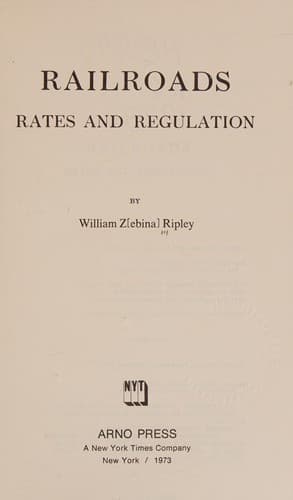
Railroads: Rates and RegulationsRipley, William Zebina
History
Railroads: Rates and Regulations
Ripley, William Zebina
Railroads -- Freight -- Rates -- United States; Railroads and state -- United States
Allowing a constructive mileage of one-third for the last named
water haul,[274] many of these even up fairly well with the all-rail
carriage; although a route from New York to Kansas City by way of
Savannah, Georgia, would appear to be an extreme case, owing to the
relatively long haul by rail.[275] The increasing importance of
Galveston and the necessity of a back haul to compensate for export
business make it possible for that city to engage in business between
New York and Kansas City, although the roundabout route is two and
one-half times as long as the direct one.[276] As compared with these
examples, it is no wonder that the competition for New York-Nashville
or New England-Chattanooga business by way of Savannah, Mobile, or
Brunswick, Georgia, is so bitter. The roundabout traffic thus reaches
around by the southern ports and nearly up again to the Ohio river.[277]
The second great class of broken rail and water shipments consists
of transcontinental business. Goods from New York to San Francisco
commonly go by way of New Orleans or Galveston,[278] as well as by
Canadian ports and routes.[279] In the opposite direction, goods are
carried about 1000 miles by water to Seattle or Vancouver before
commencing the journey east. But more important, as illustrating this
point, is the traffic from the Central West which reaches the Pacific
coast by way of Atlantic seaports. As far west as the Missouri, the
actual competition of the trunk lines on California business has since
1894[280] brought about the condition of the "blanket" or "postage
stamp" rate. The same competitive conditions which open up Denver or
Kansas City to New York shippers by way of New Orleans or Galveston,
enable the Southern Pacific Railroad or Cape Horn routes to solicit
California shipments in western territory to be hauled back to New
York, and thence by water all or part of the way to destination.
How important this potential competition is--that is to say, what
proportion of the traffic is interchanged by this route--cannot readily
be determined.
Public-domain text, read in full here on John Shaqi.
Reviews
Reviews
No reviews yet
Be the first to share your thoughts on this work.
Elsewhere in the archive
Join the Discussion
Join the discussion
Sign in to leave a comment or review.
Sign InorCreate an account