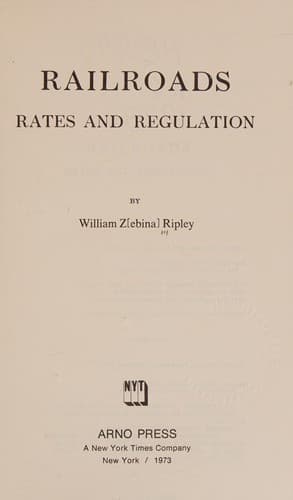
Railroads: Rates and RegulationsRipley, William Zebina
History
Railroads: Rates and Regulations
Ripley, William Zebina
Railroads -- Freight -- Rates -- United States; Railroads and state -- United States
Transportation over undue distances--the carriage of coals to
Newcastle in exchange for cotton piece goods hauled to Lancashire--as
a product of keen commercial competition may involve both a waste of
energy and an enhancement of prices in a manner seldom appreciated.
The transportation of goods great distances at low rates, while
economically justifiable in opening up new channels of business,
becomes wasteful the moment such carriage, instead of creating new
business, merely brings about an exchange between widely separated
markets, or an invasion of fields naturally tributary to other centres.
The wider the market, the greater is the chance of the most efficient
production at the lowest cost. The analogy at this point to the
problem of protective tariff legislation is obvious. For a country
to dispose of its surplus products abroad by cutting prices may not
involve economic loss; but for two countries to be simultaneously
engaged in "dumping" their products into each other's markets is quite
a different matter. In transportation such cases arise whenever a
community, producing a surplus of a given commodity, supplies itself,
nevertheless, with that same commodity from a distant market. It may
not be a just grievance that Iowa, a great cattle raising state, should
be forced to procure her dressed meats in Chicago or Omaha;[281] for
in this case some degree of manufacture has ensued in these highly
specialized centres. But the practice is less defensible where the
identical product is redistributed after long carriage to and from a
distant point. Arkansas is a great fruit raising region; yet so cheap
is transportation that dried fruits, perhaps of its own growing, are
distributed by wholesale grocers in Chicago throughout its territory.
The privilege of selling rice in the rice-growing states from Chicago
is, however, denied by the Southern Railway Association.[282] An
illuminating example of similar character occurs in the Southern cotton
manufacture, as described by a Chicago jobber:
"Right in North Carolina there is one mill shipping 60 carloads
of goods to Chicago in a season, and a great many of these same
goods are brought right back to this very section.... I might
add that when many of these heavy cotton goods made in this
southeastern section are shipped both to New York and Chicago
and then sold and reshipped South, they pay 15 cents to 20
cents per hundred less each way to New York and back than _via_
Chicago. This doubles up the handicap against which Chicago
is obliged to contend and renders the unfairness still more
burdensome."[283]
The overweening desire of the large centres to enter every market is
well exemplified by recent testimony of the Chicago jobbers.[284]
Public-domain text, read in full here on John Shaqi.
Reviews
Reviews
No reviews yet
Be the first to share your thoughts on this work.
Elsewhere in the archive
Join the Discussion
Join the discussion
Sign in to leave a comment or review.
Sign InorCreate an account