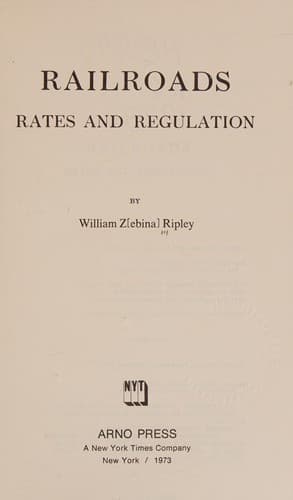
Railroads: Rates and RegulationsRipley, William Zebina
History
Railroads: Rates and Regulations
Ripley, William Zebina
Railroads -- Freight -- Rates -- United States; Railroads and state -- United States
The Iowa Central, cutting across the four main lines between Chicago
and Omaha, derives a large revenue from such diversion. Coal from
Peoria west, instead of moving by the shortest line to Omaha, is hauled
across the first three to a connection with the devious Great Western
line.[300] The motive is obvious.
A fourth cause of diversion of traffic has to do rather with the
operating than the traffic department. An inequality of tonnage in
opposite directions may make it expedient to solicit business for
the sake of a back load. The Canadian Pacific may engage in San
Francisco-Omaha business by way of Winnipeg, because of the scarcity
of tonnage east bound. The traffic to and from the southeastern states
is quite uneven in volume. The preponderance of bulky freight is north
bound to the New England centres of cotton and other manufacture;
while from the western cities, the greater volume of traffic is south
bound, consisting of agricultural staples and food stuffs. To equalize
this traffic it may often be desirable to secure the most roundabout
business. A disturbing element of this sort in the southern field has
always to be reckoned with. A good illustration elsewhere occurs in the
well known St. Cloud case.[301] The Northern Pacific accepted tonnage
for a most circuitous haul to Duluth, but seems to have done so largely
in order to provide lading for a preponderance of "empties." In this
case it did not lower the normal rate but accepted it for a much longer
haul.
Not unlike the preceding cause, also, is a fifth, the desire to be in
position to interchange traffic on terms of equality with powerful
connections. Mr. Bowes, traffic manager of the Illinois Central,
justifying the participation of this road in Chicago-San Francisco
business by way of New Orleans, well stated it as follows:[302]
"Of course the Southern Pacific Railroad, as you gentlemen
know, originate and control a very large traffic, which they
can deliver at various junctions; at New Orleans, where they
have their long haul to the Missouri river, and we naturally
want some of that business, a long haul traffic to New Orleans,
and in giving it to them we place them under obligations to
reciprocate and give us some traffic. That is one of the things
that occurs to a railroad man as to increasing the volume and
value of his traffic for the benefit of his company."
Public-domain text, read in full here on John Shaqi.
Reviews
Reviews
No reviews yet
Be the first to share your thoughts on this work.
Elsewhere in the archive
Join the Discussion
Join the discussion
Sign in to leave a comment or review.
Sign InorCreate an account